
 By Walker Evans

Picture this: you are watching your child line up toy cars with the focus of a tiny museum curator. Or maybe you are calling their name and getting… nothing. Not “I’m ignoring you,” nothing. More like “I didn’t hear the channel you’re on,” nothing. Your stomach does that quiet flip. You wonder if you are overthinking it. Then you wonder if you are underthinking it.
If you are here because autism spectrum disorder is on your radar, you are not alone. Parents usually arrive at this topic the same way they arrive at most life-changing topics: through a mix of love, worry, late-night Googling, and that small voice that says, “I should probably understand this better.”
This guide is meant to do three things: explain autism spectrum disorder in plain language, walk you through common signs and types (and why labels can be confusing), and give you practical next steps plus trustworthy resources. It’s not a diagnosis. It is a map for the next part of the road.
Key Takeaways
- ASD is a spectrum, so it can look different in every child.
- Look for patterns over time, not one behavior.
- Early signs often show up in communication, play, routines, or sensory responses.
- Screening isn’t a diagnosis, it’s a step toward clarity.
- You can start support before a diagnosis if delays are present.
- Meltdowns are often an overload, not “bad behavior.”
- The best plan is tailored to your child’s needs and strengths.
What does Autism Spectrum Disorder (ASD) mean?
Autism spectrum disorder (often shortened to ASD) is a developmental disability linked to differences in the brain. CDC states that people with ASD often experience difficulties in social communication and interaction, plus restricted or repetitive behaviors or interests. Many also have differences in learning, movement, attention, or sensory processing.
The word “spectrum” matters. It does not mean “a little autistic” to “very autistic” in a simple straight line. It means there is a wide range of strengths, supports needed, communication styles, sensory profiles, and day-to-day experiences. Two kids can both be autistic and look completely different in the classroom, at the playground, and at home.
And yes, it’s normal to feel whiplash when you hear both of these things at once:
- Autism can bring real challenges that deserve support.
- Autism can also come with real strengths and a different way of noticing the world.
Both can be true on the same Tuesday.
Signs parents often notice first
Let’s get one thing out of the way. Many behaviors associated with autism spectrum disorder can also show up in kids who are not autistic. That is why patterns matter. Context matters. Development over time matters.
So, what patterns commonly raise questions?
1. Social communication and interaction differences
Some signs are subtle. Others are the kind that snap into focus only after you learn what to look for.
In babies and toddlers
A parent might notice things like limited eye contact, fewer shared smiles, or less back-and-forth social play. Sometimes a child is slow to respond to their name or doesn’t consistently point to show interest in something.
Is that always autism? No. Hearing, temperament, language exposure, and many other factors can play a role. Still, if you keep thinking “Something feels off,” you are allowed to take that seriously.
In preschool and early school years
You may see difficulties with peer play, pretend play that differs from peers’, or challenges with conversation and turn-taking. Some kids want friends but don’t quite know how to enter the game. Others seem perfectly content being “near” other kids without really engaging with them.
One tricky piece: some children learn to “mask,” meaning they copy social behaviors to fit in. That can make things look smoother on the surface while the child feels exhausted inside. If your child comes home and melts down after holding it together all day, that’s not you failing at parenting. That’s a nervous system that ran a marathon.
2. Restricted or repetitive behaviors and focused interests
This is the category that often gets misunderstood as “quirky” or “stubborn,” when it may actually be a coping strategy.
You might notice repetitive movements (hand flapping, rocking), repeating phrases, or a desire for routines to stay the same. You may also see deep, intense interests. Not casual, “I like dinosaurs.” More like “I have appointed myself Chief Dinosaur Officer and I will now deliver a twenty-minute lecture.”
Changes can be hard, and not because a child is trying to be difficult. Predictability can feel like safety.
3. Sensory differences
Sensory processing is a big deal for many autistic people. A buzzing light, scratchy tag, crowded hallway, or certain food textures can feel genuinely overwhelming. On the flip side, a child might seek sensory input through spinning, jumping, chewing, or squeezing into tight spaces.
If your child reacts “too strongly” to sounds or textures, it may not be drama. It may be an honest brain and body response.
4. Strengths you might see, too
It is easy to focus only on challenges, especially when you are tired and trying to get through breakfast without a fight.
Still, many autistic kids show strengths like strong memory, deep focus, pattern recognition, honesty, creativity, and unique problem-solving. Some communicate in beautifully direct ways. Others notice details everyone else misses. Autism is not a personality. It is a neurodevelopmental profile. Your child is still your child, not a checklist.
Types of autism and why the labels feel confusing?
Parents often ask, “What type is it?” That question makes sense because older terms are still floating around in schools, family conversations, and online communities.
Today, the diagnosis is generally autism spectrum disorder with specifiers, meaning clinicians describe a person’s support needs and profile rather than placing them into separate categories like in the past.
What might you hear in current evaluations?
Clinicians may describe ASD in terms of support needs, often discussed as levels of support. They may also specify things like:
- Whether there is an intellectual disability
- Whether there is a language delay
- Whether there are associated medical or genetic conditions
- Whether there are co-occurring conditions like ADHD or anxiety
This approach acknowledges the spectrum reality: support needs can be different across settings. A child may do fine at home and struggle at school, or vice versa.
What might you still hear from older language?
You may hear terms like Asperger syndrome or PDD NOS from older reports or casual conversation. Those are older diagnostic categories that many people still identify with culturally, even though the clinical language has shifted. It’s okay to ask a provider, “When you say autism spectrum disorder, what does that mean for my child specifically?”
Because that’s the real question, isn’t it?
Screening and evaluation: what actually happens next?
Here is the part that can feel intimidating, mainly because it involves appointments, waiting lists, and the general vibe of “adult paperwork.”
Take a breath. The process is usually step-by-step.
Developmental screening and autism screening
The American Academy of Pediatrics recommends autism screening for all children at 18 and 24 months, along with regular developmental surveillance.
Screening is not a diagnosis. It’s more like a flashlight. It helps identify whether a child should receive a more detailed evaluation.
A full diagnostic evaluation
If screening or ongoing observation raises concerns, families are often referred for a formal developmental evaluation. This can involve specialists such as developmental pediatricians, psychologists, speech language pathologists, and occupational therapists.
Expect questions about your child’s development, communication, behavior, sensory preferences, daily living skills, and how they interact in different environments. Providers may use structured tools and direct observation. It can feel intense. It is also meant to be thorough.
Here’s a parent-friendly way to think about it
On the one hand, you want answers now. On the other hand, a careful evaluation is worth the time because it shapes support and services. Both feelings can sit in the same chair.
Why does early support matter even before a diagnosis?
This is one of the most important points parents miss because nobody shouts it from the rooftops (and honestly, they should).
If a child has developmental delays, it is appropriate to start intervention based on needs, even while waiting for a full autism evaluation. The AAP emphasizes referral for intervention when delays are identified, without waiting for a diagnostic evaluation to be completed.
In many regions, early intervention services are available for children under age three, and families can request an evaluation through their early intervention system.
So if you are thinking, “Should I wait?” the kinder answer is usually, “Let’s support what’s hard right now.”
Support options that can help, and how to choose without losing your mind?
If you are new to this world, every recommendation can sound like a sales pitch. “This program is life changing.” “That therapy is essential.” “This approach is the gold standard.” Your head starts to feel like a browser with thirty tabs open.
Let’s simplify.
Common supports
Many families use a mix of:
- Speech language therapy for communication
- Occupational therapy for sensory processing and daily living skills
- Behavioral supports to build functional skills and reduce unsafe behaviors
- Social communication supports in school and community settings
- Parent coaching to make strategies realistic at home
MedlinePlus offers a helpful overview of treatment and therapy categories and points families to reputable sources.
A nuance that matters
There isn’t one perfect plan for every autistic child. Outcomes depend on the individual profile, the environment, and whether support respects the child’s needs and dignity. If you ever feel pressured into a one-size-fits-all plan, you are allowed to ask, “How will you tailor this to my child?”
That question is not “being difficult.” It is being a good parent.
Practical strategies you can try at home this week
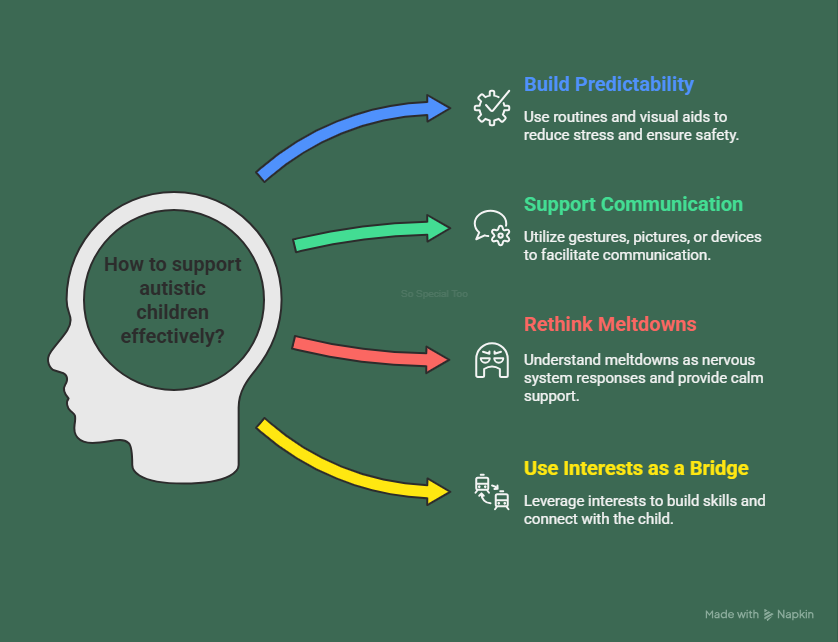
Not someday. Not when you have a new planner. This week.
Build predictability without becoming a robot
Routines can help many autistic children feel safe. But routines don’t have to be rigid. Visual schedules, simple morning checklists, and consistent transitions can reduce stress.
If transitions are hard, try giving a heads up:
- “In five minutes, we are switching.”
- “Two more turns.”
- “Last video, then bath.”
Support communication in a way that your child can use
If spoken language is limited or inconsistent, communication supports may include gestures, pictures, or communication devices. The goal is communication, not a specific method.
A proper gut check: if your child is melting down, ask yourself, “What might they be trying to communicate?” Hunger? Overload? Confusion? A demand that feels too big?
Rethink meltdowns
Meltdowns are not tantrums with extra volume. A meltdown is often a nervous system overload response. Your job in that moment is less “teach a lesson” and more “help them come back to baseline.”
Lower your voice. Reduce language. Offer a calm space. If you can, remove sensory triggers. Afterward, you can problem-solve together.
Use interests as a bridge, not a bargaining chip
If your child loves trains, letters, space, or numbers, you can use that interest to build skills. Read train books together. Practice turn-taking with train games. Use train visuals for schedules.
It is not “letting them obsess.” It is meeting them where they are.
School supports and what to ask for?
If your child is school age, you may hear about plans and accommodations. Terms vary by country and region, but the principle is consistent: the environment should adapt so your child can learn.
Helpful supports can include:
- Clear routines and predictable transitions
- Reduced sensory load when possible
- Movement or sensory breaks
- Visual supports and simplified instructions
- Social support during unstructured times, like recess
When you meet with the school, try this question: “What does a successful day look like for my child here, and what supports make that possible?” It keeps the conversation practical.
Common myths and parent worries, handled gently
No. Autism is not caused by parenting style. The origins are complex, involving genetic and environmental factors, and researchers do not point to one single cause.
This question comes up because it has been loudly debated in public, even though the research base is strong. A large evidence-based meta-analysis found no association between vaccination and autism or autism spectrum disorder.
If you feel anxious about this topic, talk to a trusted clinician who can walk you through evidence and answer your specific questions.
Autism is a lifelong neurodevelopmental condition. Many people learn skills, build independence, and thrive with the proper support. At the same time, it is not something you “cure” like an infection. A better frame is: “What supports help my child communicate, learn, and feel safe in their world?”
Absolutely. Affection can show up in many forms. Some autistic children are highly cuddly, others prefer side-by-side connection, and some shift between the two depending on sensory comfort and mood.
Academic strength does not rule out autism. Some children excel in academics while struggling with social communication, sensory regulation, or flexibility in daily routines.
If you are noticing persistent developmental differences, it is usually better to screen and seek support early rather than wait.

What do parents often need most?
When families are overwhelmed, it is rarely because they don’t love their child enough. It is because they are juggling appointments, school calls, sensory struggles, sleep issues, and the emotional weight of uncertainty.
So let’s make the next step simple.
If you suspect autism spectrum disorder, consider doing these three things:
- Write down what you notice, including situations that go well and situations that fall apart
- Ask your pediatrician or primary provider about screening and referrals
- Pursue support for identified delays without waiting for a final label
Small steps, taken early, can make a real difference.
How So Special Too can support your family?
You do not have to figure everything out alone. So Special Too is built around practical support for families, including consultation services, workshops, therapy-oriented guidance, and a shop with sensory tools and stimulating toys designed to support development and regulation.
If you want a personalized plan and someone to help you sort through “what matters most right now,” consult a specialist. If your day-to-day challenge is sensory overload, focus, or calming routines, explore their sensory tools and supports and choose what fits your child, not what looks good in someone else’s Instagram reel.




