
 By Walker Evans
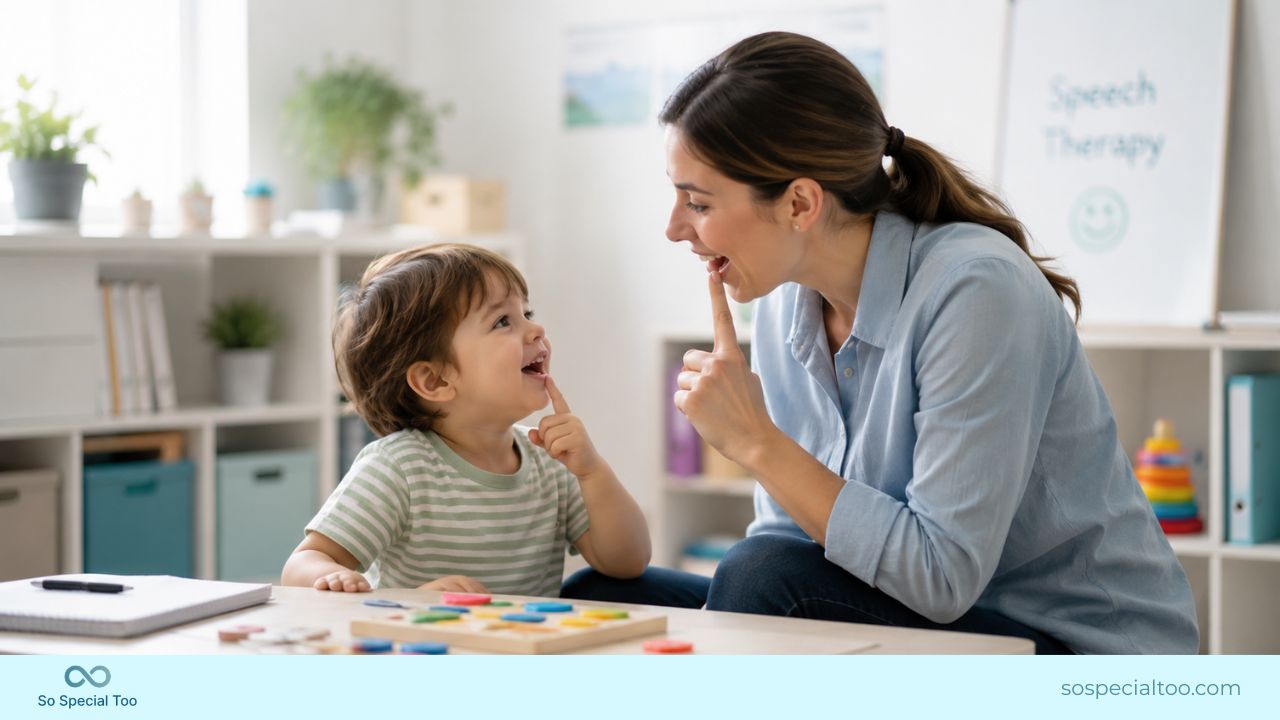
Parents often wonder whether their child is developing communication skills at their own pace or may benefit from professional support. While every child develops differently, persistent difficulty with speaking, understanding language, producing clear sounds, or participating in conversations may be a reason to speak with a speech therapist.
A speech therapist for child communication concerns can assess much more than the number of words a child says. An evaluation may examine how a child understands language, expresses ideas, produces speech sounds, speaks fluently, uses their voice, communicates socially, and manages feeding or swallowing when relevant.
Missing one communication milestone does not automatically mean that a child has a speech or language disorder. However, parents should consider an evaluation when communication difficulties continue over time, interfere with everyday activities, cause frequent frustration, or occur alongside concerns involving hearing, play, learning, movement, or social interaction.
A loss of previously acquired words, gestures, speech clarity, or other communication abilities should be discussed with a healthcare professional promptly.
Key Takeaways
Recognizing possible communication difficulties early can help families understand whether a child needs monitoring, home support, hearing testing, or a full speech-language evaluation.
- A child may need an evaluation for delayed language, unclear speech, difficulty understanding directions, stuttering, voice changes, or social communication concerns.
- Temporary or permanent hearing difficulties can affect speech and language development.
- Speaking more than one language does not cause a speech or language disorder.
- A speech evaluation does not automatically mean that a child needs ongoing therapy.
- Parents can request an assessment without waiting for communication difficulties to become severe.
- Sudden loss of communication skills, voice changes, or swallowing difficulties requires prompt medical guidance.
What Does a Speech Therapist Do for a Child?
A speech therapist, formally called a speech-language pathologist, evaluates and treats communication and swallowing difficulties. The therapist may assess receptive language, which is how a child understands words, questions, and directions, as well as expressive language, which is how the child communicates needs, thoughts, questions, and experiences.
Speech-language pathologists may also assess:
- Speech sound production
- Fluency and stuttering
- Voice quality
- Social communication
- Oral-motor function
- Feeding and swallowing
- Augmentative and alternative communication needs
Therapy activities are selected according to the child’s age, abilities, interests, and individual goals. Sessions may involve play, books, pictures, movement, storytelling, sound practice, conversation, or supportive communication methods.
The National Institute on Deafness and Other Communication Disorders’ overview of speech and language development explains that children generally develop communication skills in a recognizable sequence, although the timing varies from child to child. It also distinguishes language difficulties from speech disorders involving sound production, fluency, voice, or motor planning.
Families looking for individualized guidance can also explore So Special Too’s speech therapy, online therapy, and consultation services, which are designed to support children and families based on their specific communication needs.
When Should a Child See a Speech Therapist?
A child should see a speech therapist when difficulties involving understanding, speaking, speech clarity, fluency, voice, or social communication continue over time or interfere with participation at home, childcare, school, or in the community.
Parents can request an evaluation even when they are unsure whether the concern is serious. An assessment identifies the child’s communication strengths and areas that may require support. It does not automatically assign a diagnosis or commit the family to ongoing therapy.
The following chart presents general signs that may justify a professional conversation. These milestones are monitoring guides rather than strict diagnostic deadlines. A clinician should consider the child’s complete developmental, medical, hearing, educational, cultural, and language history.
| Age or Stage | Communication Skills Often Emerging | Reasons to Consider an Evaluation |
| By 12 to 15 months | Babbling, responding to familiar voices, using gestures, and beginning to use meaningful words | Rarely responds to sounds or their name, uses very few gestures, makes limited attempts to communicate, or stops babbling |
| Around 18 months | Tries several words, points to share interest, and follows a familiar one-step direction | Uses very few meaningful words, does not point to communicate, cannot follow familiar directions, or appears not to hear consistently |
| Around 2 years | Combines at least two words, uses several gestures, and points to named objects or body parts | Does not combine words, has difficulty understanding simple requests, relies mainly on crying or pulling adults, or becomes highly frustrated |
| Around 3 years | Participates in short conversations, asks simple questions, and is understood most of the time | Rarely joins back-and-forth conversation, uses very limited sentences, or remains difficult for familiar adults to understand |
| Preschool or school age | Uses longer sentences, tells simple stories, follows classroom directions, and communicates with peers | Has persistent sound errors, limited vocabulary, difficulty retelling events, stuttering, voice problems, or social communication difficulties |
| Any age | Communication continues expanding and becoming more effective | Loses words or other skills, develops sudden speech or voice changes, has swallowing concerns, or experiences communication problems that substantially affect daily life |
The American Speech-Language-Hearing Association’s early identification guidance provides additional age-based signs that parents can use when monitoring speech, language, hearing, feeding, and swallowing development.
Parents who are also monitoring broader developmental patterns may find it helpful to read about the relationship between early milestones and autism.
What Are the Signs of a Possible Language Delay?
Language difficulties can affect understanding, expression, or both. Some children understand what others say but struggle to communicate their own ideas. Others may speak frequently while having difficulty understanding questions, directions, or concepts.
A child with a receptive language difficulty may struggle to:
- Follow familiar directions
- Answer questions appropriately
- Identify familiar objects
- Understand commonly used words
- Follow classroom conversations
- Understand stories or explanations
A child with an expressive language difficulty may understand more than they can say but use fewer words, shorter sentences, or less varied language than expected. Parents may notice that the child relies heavily on pointing, crying, or physically leading an adult to a desired object.
Other possible concerns include difficulty learning new words, limited sentence growth, trouble describing experiences, or repeating memorized words without using them flexibly. Some children may know many labels but struggle to request help, answer questions, explain what happened, or participate in back-and-forth conversation.
The American Academy of Pediatrics explains in its guidance for parents concerned about toddler language delays that an assessment may include hearing testing and an evaluation by a speech-language pathologist. A language delay can occur independently, but it may also appear alongside hearing loss, broader developmental delays, autism, or another developmental difference.
When Does Unclear Speech Need an Evaluation?
Pronunciation mistakes are common while children are learning speech sounds. Some sounds develop earlier than others, and children may simplify difficult words while their speech system is still developing.
An evaluation may be helpful when a child is much harder to understand than other children of a similar age, avoids speaking, becomes frustrated when asked to repeat words, or has persistent errors that affect confidence, relationships, classroom participation, or learning.
Parents may also notice that the child:
- Leaves sounds out of words
- Replaces many sounds with the same sound
- Has difficulty moving smoothly between sounds
- Speaks clearly in some situations but not others
- Becomes upset when listeners do not understand
- Avoids names or words that are difficult to pronounce
A speech-language pathologist considers the child’s age, error patterns, hearing, oral movement, voice, motor planning, dialect, and all languages used before deciding whether support is needed. Differences connected to a child’s accent, dialect, or multilingual development should not automatically be treated as a disorder.
Should a Child See a Speech Therapist for Stuttering?
Some repetition and hesitation can occur as children rapidly develop vocabulary and sentence skills. A child may repeat an entire word, pause, revise a phrase, or restart a sentence while deciding what to say. These ordinary disruptions may come and go.
A speech-language evaluation becomes more important when stuttering persists, increases, or includes:
- Repetition of sounds or parts of words
- Stretching or prolonging sounds
- Visible facial or body tension
- Blocks in which speech appears stuck
- Avoidance of particular words or speaking situations
- Embarrassment, anxiety, or frustration about talking
The American Speech-Language-Hearing Association’s clinical information on fluency disorders notes that stuttering may involve repetitions, prolongations, blocks, and physical tension. The emotional or social effect on the child can also be important, even when the amount of observable stuttering appears limited.
Parents can support a child by listening calmly, maintaining natural eye contact, and allowing enough time for the child to finish. Frequently telling the child to slow down, take a breath, think before speaking, or start again may increase communication pressure rather than improve fluency.
Why Should a Child’s Hearing Be Checked?
A child may respond to some sounds while still having difficulty hearing speech clearly. Ear infections, fluid in the middle ear, or permanent hearing loss can affect how well a child hears words and individual speech sounds.
Possible signs of hearing difficulty include:
- Responding inconsistently to their name
- Watching people’s faces closely while they speak
- Turning televisions or devices up loudly
- Frequently asking for repetition
- Appearing inattentive during spoken directions
- Having delayed speech or language development
- Speaking more loudly than expected
- Struggling to understand speech in noisy places
When ear infections or fluid occur repeatedly, a child may miss important speech sounds and words even when there is no obvious pain or fever.
Hearing testing can identify difficulties that are easy to miss during everyday activities. An audiologist may assess hearing before or alongside a speech-language evaluation so the professionals involved can recommend appropriate support.
Does Bilingualism Cause Speech Delay?
Speaking two or more languages does not cause a speech or language disorder. Multilingual children may divide their vocabulary across languages, mix languages within a sentence, or use speech patterns influenced by each language. These differences can be part of typical multilingual development.
A genuine communication disorder generally affects a child’s overall ability to understand or communicate across the languages they use, although the signs may not appear in exactly the same way in every language.
The American Speech-Language-Hearing Association’s guidance on multilingual development explains that using multiple languages does not confuse children or cause speech and language problems. Families are encouraged to communicate in the languages they know and use most comfortably.
Parents should not stop using a home language in an attempt to correct a suspected delay. Natural conversations, songs, books, storytelling, family routines, and play in the family’s strongest languages provide valuable communication opportunities. They also help children maintain meaningful relationships with relatives and their wider community.
A speech-language evaluation for a multilingual child should consider skills across languages rather than judging the child entirely through one language.
What Happens During a Speech-Language Evaluation?
A speech-language evaluation is tailored to the child’s age, abilities, communication methods, and comfort level. The clinician may review medical history, hearing, developmental milestones, school performance, family concerns, and the languages spoken at home.
For younger children, assessment often happens through play. The therapist may observe how the child:
- Follows directions
- Requests objects or help
- Names familiar items
- Combines words
- Produces speech sounds
- Answers questions
- Takes turns
- Interacts with caregivers
- Uses gestures, pictures, signs, or communication devices
Standardized tests may be used, but they are only one part of the evaluation. Observations, caregiver input, teacher feedback, language samples, and home videos may also help create a clearer picture of the child’s communication abilities.
Cleveland Clinic Children’s explains that pediatric speech evaluations may combine play-based activities with standardized testing. Toys, stories, games, and everyday interactions allow the clinician to observe what a child understands, how they communicate, and what kinds of support may be appropriate.
Parents should receive an explanation of the results, including the child’s strengths, the areas of concern, and the recommended next steps.
Does an Evaluation Automatically Mean Therapy?
An assessment does not automatically mean that a child needs therapy. It may show that communication skills fall within an expected range, although monitoring may still be recommended. It may also identify an area that can be supported through small changes in everyday interactions.
Possible recommendations may include:
- Monitoring development for a defined period
- Using communication-building strategies at home
- Completing a hearing evaluation
- Consulting another healthcare or developmental professional
- Receiving school-based support
- Beginning direct speech-language therapy
When therapy is appropriate, its frequency and duration depend on the child’s needs, the nature and severity of the concern, the service setting, attendance, progress, and family participation. Goals should be individualized rather than based on an identical program for every child.
One child may work on combining words, while another practices understanding directions, producing sounds clearly, speaking more comfortably, expanding storytelling, using an augmentative communication system, or communicating with classmates.
Progress may happen gradually, and goals may change as the child develops new abilities.
How Can Parents Prepare for the Appointment?
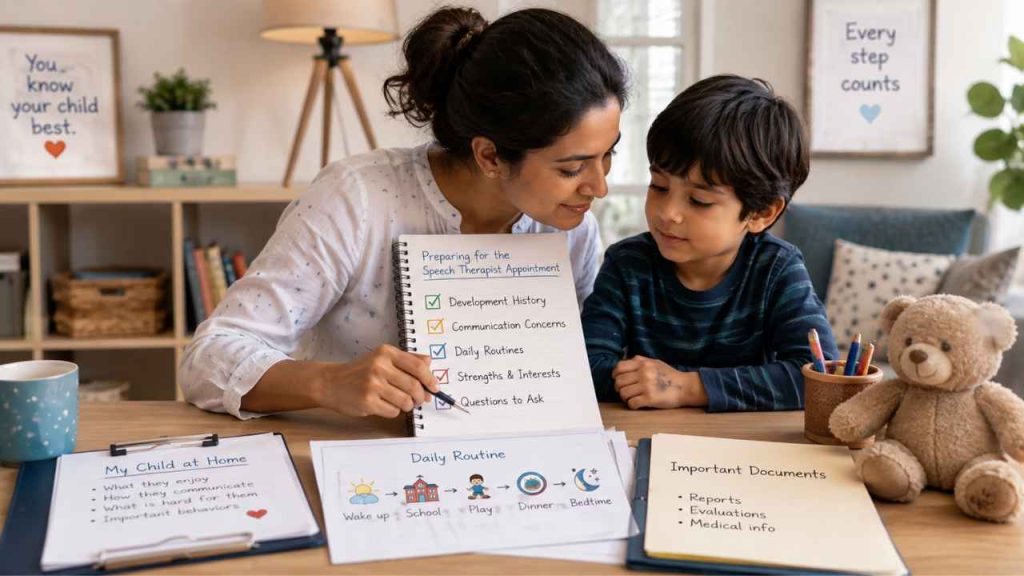
Preparing a few observations before the appointment can help the speech-language pathologist understand how the child communicates during everyday life.
Parents may want to record:
- Words, gestures, and sentence types the child currently uses
- How the child requests food, toys, help, or attention
- Whether the child understands familiar directions
- Situations in which communication becomes difficult
- Differences between communication at home and school
- Episodes of frustration connected to speaking or understanding
- Any skills the child previously used but has stopped using
Bring relevant information about hearing tests, ear infections, medical history, earlier evaluations, school reports, and teacher concerns. Short videos of natural conversation or play may show communication skills that do not appear during a clinic visit.
Parents do not need to drill, rehearse, or coach the child before the assessment. The goal is to understand typical communication strengths and difficulties, not to determine whether the child can produce rehearsed answers.
It can also help to prepare questions about the results, recommended goals, expected therapy frequency, home activities, and how progress will be measured.
How Can Families Access Speech Therapy?
Families can begin by speaking with the child’s pediatrician or primary healthcare provider, who may recommend hearing testing, developmental screening, or a referral to a speech-language pathologist. Some private clinics accept direct appointments, although referral and insurance requirements vary.
In the United States, children younger than age 3 may qualify for early intervention services. Children age 3 and older may be evaluated through the local public school system. Families in Canada can ask their family doctor, pediatrician, school, regional health authority, or private speech-language pathology provider about local assessment options.
Eligibility requirements differ between healthcare, early intervention, school, and private programs. A child may qualify for help in one setting but not another.
Supportive communication methods such as gestures, pictures, visual schedules, signs, or augmentative communication systems can be used while a family is waiting for an evaluation. These methods support communication and do not prevent speech from developing.
Families interested in supplemental materials for reading, sound awareness, and communication practice can browse So Special Too’s communication-focused learning products. These tools should support professional recommendations and everyday interaction rather than replace an individualized evaluation or therapy plan.
FAQs
Can Parents Contact a Speech Therapist Without a Referral?
Often, yes. Many private speech-language pathology clinics allow families to request an assessment directly. However, insurance plans, public programs, healthcare systems, and individual clinics may have different referral requirements.
Does a Speech Evaluation Mean a Child Needs Therapy?
No. Recommendations may include monitoring, home strategies, hearing testing, another professional referral, school support, or direct therapy. The evaluation is intended to identify the child’s strengths and determine whether additional support is necessary.
Can Speech Therapy Help a Child Who Already Talks?
Yes. Speech therapy is not limited to children who have few or no spoken words. It may address speech clarity, vocabulary, sentence development, comprehension, fluency, voice, storytelling, social communication, or the ability to organize and explain ideas.
How Long Does a Child Need Speech Therapy?
The duration varies according to the type and severity of the concern, the child’s goals, attendance, service setting, family involvement, and progress. Some children need short-term support, while others benefit from therapy over a longer period.
Should Parents Wait to See Whether a Late Talker Catches Up?
Parents do not need to wait until a delay becomes severe. Some late talkers catch up without ongoing therapy, while others have persistent language difficulties. An evaluation can help distinguish between a child who may benefit from monitoring and one who needs more immediate support.
Conclusion
A speech therapist for child communication concerns can assess understanding, expression, speech clarity, fluency, voice, social communication, and, when appropriate, feeding and swallowing.
Parents should seek professional guidance when communication difficulties persist, interfere with everyday activities, affect learning or relationships, or cause frequent frustration. Hearing should also be considered because a child may respond to some sounds while still having difficulty hearing speech clearly.
An evaluation does not automatically mean that a child will need long-term therapy. It can clarify whether monitoring, hearing testing, home strategies, additional assessment, or direct treatment is appropriate.
Loss of words, gestures, speech clarity, or other acquired abilities, as well as sudden changes in speech, voice, or swallowing, should be discussed with a healthcare professional promptly. When parents have concerns, requesting an evaluation can provide clearer answers and help the family choose the right next step.




