
 By Walker Evans
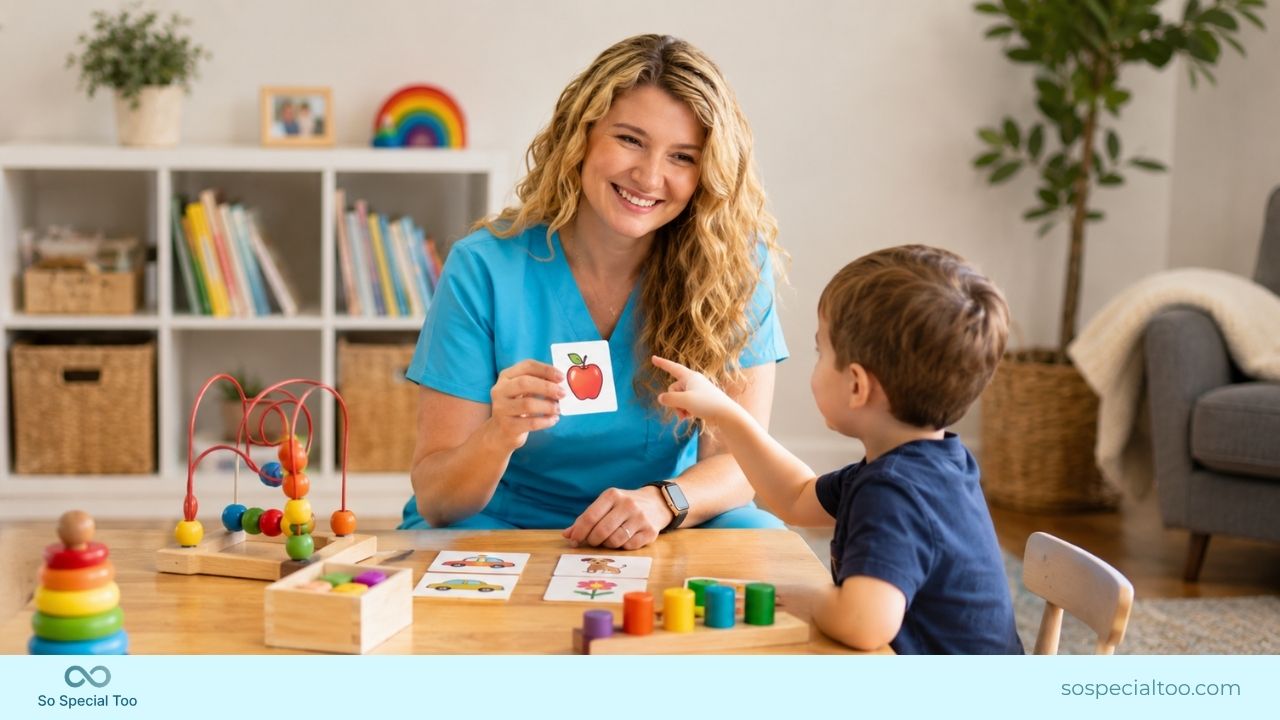
Speech therapy at home can help children practice communication during familiar routines, play, meals, shared reading, and everyday family interactions. These activities give children more opportunities to listen, take turns, use gestures, learn new words, combine phrases, and improve speech clarity in situations that feel safe and natural.
Home practice is most effective when it is simple, enjoyable, repeated regularly, and matched to the child’s age, attention span, communication level, and individual goals. Parents do not need special equipment, complicated worksheets, or long lessons to support communication. A few focused minutes throughout the day can be more helpful than one lengthy practice session.
Talking during dressing, singing in the car, naming foods at mealtime, or taking turns with a favorite toy can all create meaningful language opportunities. The purpose is not to pressure a child to speak perfectly or repeat words on demand. It is to make communication useful, successful, and rewarding.
Speech therapy activities at home should support, not replace, evaluation or treatment from a qualified speech-language pathologist. Professional guidance is especially important when a child has persistent communication difficulties, loses previously acquired skills, or has trouble understanding or expressing language.
Key Takeaways
Small changes in everyday interactions can create valuable opportunities for children to practice communication without making home life feel like a therapy session.
- Speech therapy at home works best when practice is included in everyday routines.
- Parents can model short phrases, pause for responses, expand a child’s words, and follow the child’s interests.
- Reading, singing, pretend play, and turn-taking can support vocabulary, listening, and social communication.
- Frequent correction or pressure to speak may increase frustration.
- Gestures, signs, pictures, sounds, and word approximations are meaningful forms of communication.
- Home practice should follow the child’s therapy plan when a speech-language pathologist is involved.
What Does Speech Therapy at Home Mean?
Speech therapy at home refers to communication activities parents and caregivers use between professional sessions or while seeking an evaluation. These activities may support expressive language, receptive language, speech sounds, fluency, social communication, gestures, or other communication methods.
The activities do not need to look like formal lessons. In many cases, the most helpful practice happens while a child is already playing, eating, getting dressed, looking at books, or spending time with family.
The National Institute on Deafness and Other Communication Disorders’ guidance on speech and language development explains that an evaluation may examine a child’s communication and general development. Hearing testing is often included because hearing difficulties can affect speech and language development. A speech-language pathologist may also recommend specific activities for families to practice at home.
The most appropriate activity will depend on the child’s individual needs. A child learning first words will need different support from a child practicing speech sounds, telling stories, following classroom directions, or communicating socially.
Speech Therapy at Home Activity Chart
Home activities are easier to maintain when they fit naturally into the family’s schedule. The following ideas can be adjusted according to a child’s age, interests, and communication goals.
| Activity | Skill Supported | How to Use It | Suggested Time |
| Picture-book reading | Vocabulary and listening | Name pictures, pause, point, and let the child turn pages | 5 to 10 minutes |
| Narrating routines | Word learning and comprehension | Describe short actions during meals, dressing, or cleanup | Throughout the day |
| Choice-making | Requesting and decision-making | Offer two visible options and wait for a word, sign, sound, or point | 1 to 2 minutes |
| Turn-taking play | Social communication | Roll a ball or push cars while saying “my turn” and “your turn” | About 5 minutes |
| Songs with pauses | Memory and imitation | Pause before a familiar word and allow time for a response | 3 to 5 minutes |
| Pretend play | Vocabulary and sequencing | Use dolls, toy food, vehicles, or household objects to act out routines | 5 to 10 minutes |
| Therapist-assigned sound practice | Speech clarity | Practice the exact sound and cue recommended by the therapist | As directed |
Several short interactions are often easier for young children than one long practice session. A parent might spend a few minutes singing in the morning, practice choices during lunch, and look at a book before bedtime.
Follow the Child’s Lead During Play
Children are more likely to communicate when they are interested and engaged. Instead of choosing an activity for the child, observe what they select and join them.
If a child pushes a toy car, a parent might say:
- “Car goes.”
- “Fast car.”
- “Red car.”
- “Ready, set, go.”
- “The car stopped.”
The goal is to add useful language without controlling the activity or asking the child to repeat every word.
Parents can imitate the child’s action, sound, facial expression, or word and then add one small variation. If the child says “up,” the parent might respond, “Block up.” If the child makes an animal sound, the parent can copy the sound and add the animal’s name.
Following the child’s lead keeps play interactive. It also reduces the risk of turning a preferred activity into a test.
Model Short, Useful Language
A language model is a simple example that a child can hear and may later imitate. The model should usually be slightly more advanced than the child’s current communication level.
A child who communicates mostly through gestures or single words may benefit from short phrases such as:
- “More juice.”
- “Open box.”
- “Big truck.”
- “Mommy help.”
- “Want bubbles.”
- “All done.”
Long explanations may be difficult for a child who is still learning to understand basic words and phrases. Short models are easier to process, remember, and use.
During bath time, parents might say, “Water in,” “Wash feet,” “More bubbles,” or “Towel on.” During cleanup, they might say, “Block in,” “Pick up,” or “All clean.”
Parents do not need to ask the child to repeat each phrase. Hearing useful language many times during meaningful situations gives the child opportunities to learn naturally.
Use the Wait-and-Respond Technique
Children may need more processing time than adults expect. After offering a choice, asking a simple question, or pausing during a familiar routine, wait quietly for several seconds.
Avoid immediately repeating the question, offering another prompt, or answering for the child. A quiet pause gives the child time to understand what was said and decide how to respond.
A response does not have to be a complete or perfectly pronounced word. It may be:
- A look
- A point
- A gesture
- A sign
- A sound
- A facial expression
- A word approximation
- A spoken word or phrase
If a child reaches toward a ball, the parent can say, “Ball. You want the ball.” This acknowledges the child’s message while providing a clear language model.
Waiting can feel uncomfortable at first, especially when adults are used to filling silence. With practice, it can become one of the easiest ways to encourage communication.
Expand What the Child Says
Expansion means repeating a child’s message and adding a small amount of information. It allows the child to hear a slightly longer or clearer version without being directly corrected.
Examples include:
- Child: “Dog.”
Parent: “Big dog.” - Child: “Baby sleep.”
Parent: “The baby is sleeping.” - Child: “More.”
Parent: “More crackers.” - Child: “Car go.”
Parent: “The car is going.”
The parent does not need to say, “No, say it properly,” or require another attempt. A natural response helps the child hear clearer grammar, vocabulary, or pronunciation while keeping the conversation moving.
Expansions should remain brief. Adding too many words may make the model difficult for the child to understand or imitate.
Read Picture Books Interactively
Shared reading can support vocabulary, attention, listening, imagination, and conversation. Young children do not need to sit through every word of a book to benefit from reading.
Parents can let the child choose the book, turn pages, point to pictures, make sound effects, or repeat a favorite section. It is also fine to skip pages or stop before finishing the story.
The American Academy of Pediatrics offers shared-reading strategies for children with speech, language, and developmental needs, including using repetition, naming pictures, discussing what is happening, and adapting the activity to the child’s abilities.
Instead of asking “What is this?” on every page, parents can combine comments with simple questions:
- “I see a red bus.”
- “The dog is sleeping.”
- “That is a big tree.”
- “Is the cat eating or sleeping?”
- “Where is the baby?”
- “What do you think happens next?”
Repeated books are useful because familiarity helps children anticipate words, remember phrases, and participate more confidently.
Build Language Through Songs and Pauses
Songs provide repetition, rhythm, predictable language, and opportunities for imitation. Familiar songs are especially useful because children may already recognize the words, sounds, or movements.
Sing slowly and pause before an expected word or action. For example, say, “Ready, set…” and wait before saying “go.” During a familiar song, pause before a repeated sound or movement.
The child may respond with a word, sound, gesture, movement, or facial expression. Any meaningful attempt can be acknowledged.
Parents can also add simple actions to songs, such as clapping, pointing, jumping, or touching body parts. Movements can help children understand the meaning of words and remain engaged.
There is no need to sing perfectly. A familiar voice, repeated words, and an enjoyable interaction matter more than musical ability.
Practice Turn-Taking Games
Communication involves taking turns, watching another person, waiting, and responding. Children can practice these skills before they use many spoken words.
Simple turn-taking activities include:
- Rolling a ball
- Pushing cars down a ramp
- Adding blocks to a tower
- Placing objects in a container
- Completing a puzzle
- Blowing bubbles
- Pretending to talk on toy phones
- Taking turns making animal sounds
Use consistent phrases such as “my turn,” “your turn,” “go,” “stop,” and “again.” Short, repeated phrases help the child connect the words with the actions.
If the child has difficulty waiting, begin with very short turns. The adult can take one quick turn and immediately return the toy. Turn-taking can be extended gradually as the child becomes more comfortable.
Offer Choices Instead of Broad Questions
Open-ended questions may be difficult for children with limited language. Offering two choices reduces the number of possible answers and provides a clear language model.
Hold up two visible items and ask:
- “Apple or banana?”
- “Blue shirt or red shirt?”
- “Blocks or cars?”
- “Milk or water?”
- “Book or bubbles?”
Pause and accept a spoken word, approximation, sign, gesture, eye gaze, or point. Confirm the choice by saying, “Banana. You chose a banana.”
Avoid requiring the child to repeat the word several times before receiving the item. This can turn a successful communication attempt into a frustrating experience.
Choices should be genuine whenever possible. Do not offer an option that the child cannot actually select.
Use Pretend Play and Daily Routines
Pretend play gives words a clear purpose. A child can feed a doll, put a toy animal to sleep, drive a bus, prepare pretend food, or give a stuffed animal a bath.
Parents can model:
- Action words such as eat, wash, pour, stir, sleep, open, and drive
- Object names such as spoon, cup, blanket, bus, and plate
- Location words such as in, on, under, beside, and behind
- Describing words such as big, small, hot, cold, fast, and wet
- Simple sequences such as “First wash, then dry”
Daily routines provide similar opportunities without requiring special toys. During laundry, parents can name clothing, sort colors, and practice words such as “in,” “out,” “wet,” and “dry.”
While cooking, they can describe washing, cutting, pouring, mixing, and stirring. During cleanup, they can practice “pick up,” “put in,” and “all finished.”
Repeating the same words during familiar routines helps children connect language with actions and objects they experience regularly.
Support Speech Sounds Without Overcorrecting
Parents should practice specific speech sounds only when they understand the target and cue recommended by the child’s speech-language pathologist. Different speech difficulties require different approaches, and a technique that helps one child may not be appropriate for another.
Some sound errors are expected while children are developing speech. Correcting every mistake can interrupt conversation and make a child reluctant to talk.
The American Speech-Language-Hearing Association advises parents to provide clear speech models without correcting every sound error. When a child says a word unclearly, respond to the meaning first and then model the word naturally.
For example, if the child says “tar” for “car,” the parent might answer, “Yes, a car. The car is fast.”
Do not pretend not to understand when the child’s message is clear. The child has already communicated successfully, even if the pronunciation was not accurate.
For therapist-assigned sound practice, follow the recommended word list, cue, number of repetitions, and practice schedule. Stop when the child becomes tired or frustrated.
Support a Child Who Stutters Without Adding Pressure
Children who stutter may repeat sounds, stretch words, pause, or experience moments when speech feels stuck. Parents can support communication by listening patiently and focusing on the child’s message.
Maintain natural eye contact and allow the child to finish. Avoid interrupting, completing sentences, or repeatedly telling the child to slow down, take a breath, or start again.
A calm speaking environment can reduce time pressure, but parents should not try to manage stuttering without professional guidance when it persists or causes distress.
Families seeking more information can read about speech therapy approaches for autistic children who stutter.
What Should Parents Avoid?
Home practice should not feel like repeated testing or a performance requirement. Communication activities should focus on connection, participation, and gradual progress rather than perfect speech.
Avoid demanding the same word many times, comparing the child with siblings, interrupting communication attempts, or criticizing pronunciation. Do not force eye contact or remove necessary items solely to make the child speak. These approaches may increase frustration and reduce the child’s willingness to communicate.
Parents should also avoid asking too many questions in a row. Constant questioning can make an activity feel like a quiz instead of a natural interaction.
Balance questions with comments and descriptions. Instead of repeatedly asking, “What is this?” say, “That is a big red truck,” and pause to give the child an opportunity to respond.
Give the child enough time to process language without immediately repeating the question or answering on their behalf. Respond to the intended message before modeling a clearer word or phrase.
Accept gestures, signs, pictures, sounds, facial expressions, communication devices, and word approximations as meaningful communication. Spoken words are not the only valid way for a child to express a need, preference, feeling, or idea.
Never withhold food, comfort, bathroom access, or another essential need until a child produces a spoken word. Stop the activity when the child is tired, overwhelmed, or visibly frustrated.
When Is a Professional Evaluation Needed?
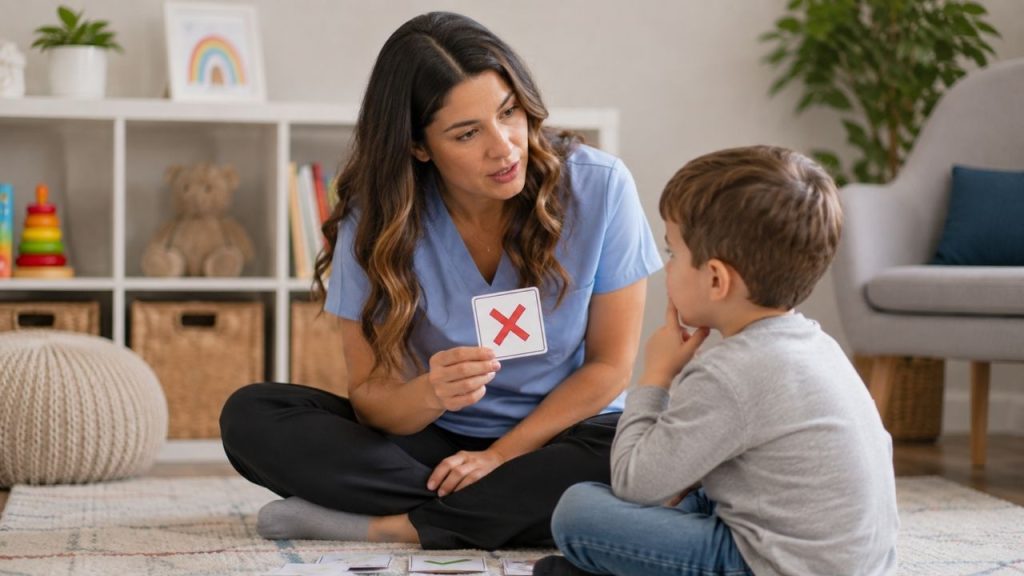
Home activities cannot identify the cause of a communication difficulty. Parents should contact the child’s pediatrician or another qualified healthcare professional when speech or language is not progressing, the child has difficulty understanding language, speech is unusually difficult to understand, or communication challenges cause frequent frustration.
Prompt evaluation is especially important when a child:
- Loses words, gestures, or other established communication skills
- Does not respond consistently to sounds or their name
- Has feeding, chewing, or swallowing concerns
- Shows sudden changes in speech or voice
- Has difficulty following familiar directions
- Experiences delays in additional developmental areas
- Avoids communication because it is difficult or upsetting
A hearing evaluation may also be appropriate because a child can respond to some sounds while still having difficulty hearing speech clearly.
Parents already working with a speech-language pathologist should ask which activities, cues, and practice frequency match the child’s goals. Home practice is most useful when it reinforces the professional plan rather than introducing unrelated exercises.
Families seeking individualized support can explore So Special Too’s speech therapy, online therapy, and consultation services. A professional evaluation can help determine whether a child needs therapy, hearing testing, developmental assessment, home strategies, or continued monitoring.
FAQs
Parents often have questions about how frequently to practice, which responses to accept, and when home activities are no longer enough.
How Long Should Speech Therapy at Home Last Each Day?
Short periods of about 5 to 10 minutes can work well, especially when practice is also included naturally in daily routines. Several brief interactions may be more manageable than one long session.
Can Home Activities Replace a Speech-Language Pathologist?
No. Home activities can support communication practice, but they cannot identify the cause of a speech or language difficulty. A professional evaluation is needed to assess the child’s abilities and create an appropriate plan.
Should Parents Correct Every Speech Mistake?
No. Respond to the child’s message first and model the clearer form naturally. Direct sound practice should follow the specific recommendations of the child’s speech-language pathologist.
Are Gestures Acceptable During Speech Practice?
Yes. Gestures, pointing, signs, pictures, facial expressions, sounds, and communication devices are valid forms of communication. They can also be paired with spoken language.
When Should Parents Worry About Lost Words?
Loss of words, gestures, or other established communication abilities should be reported promptly to the child’s pediatrician or another qualified healthcare professional.
Conclusion
Speech therapy at home is most useful when practice is brief, responsive, enjoyable, and connected to everyday life. Reading, songs, choices, pretend play, expansions, and turn-taking create meaningful opportunities for children to communicate without pressure.
Parents can support progress by following the child’s interests, modeling simple language, waiting for responses, and acknowledging all meaningful communication attempts. Frequent correction, repeated testing, and pressure to speak can make communication more difficult and frustrating.
When therapy is already underway, home activities should reinforce the goals and techniques recommended by the child’s speech-language pathologist. Parents should request a professional evaluation when communication progress is limited, skills are lost, speech is difficult to understand, or hearing and broader development are concerns.




