
 By Walker Evans
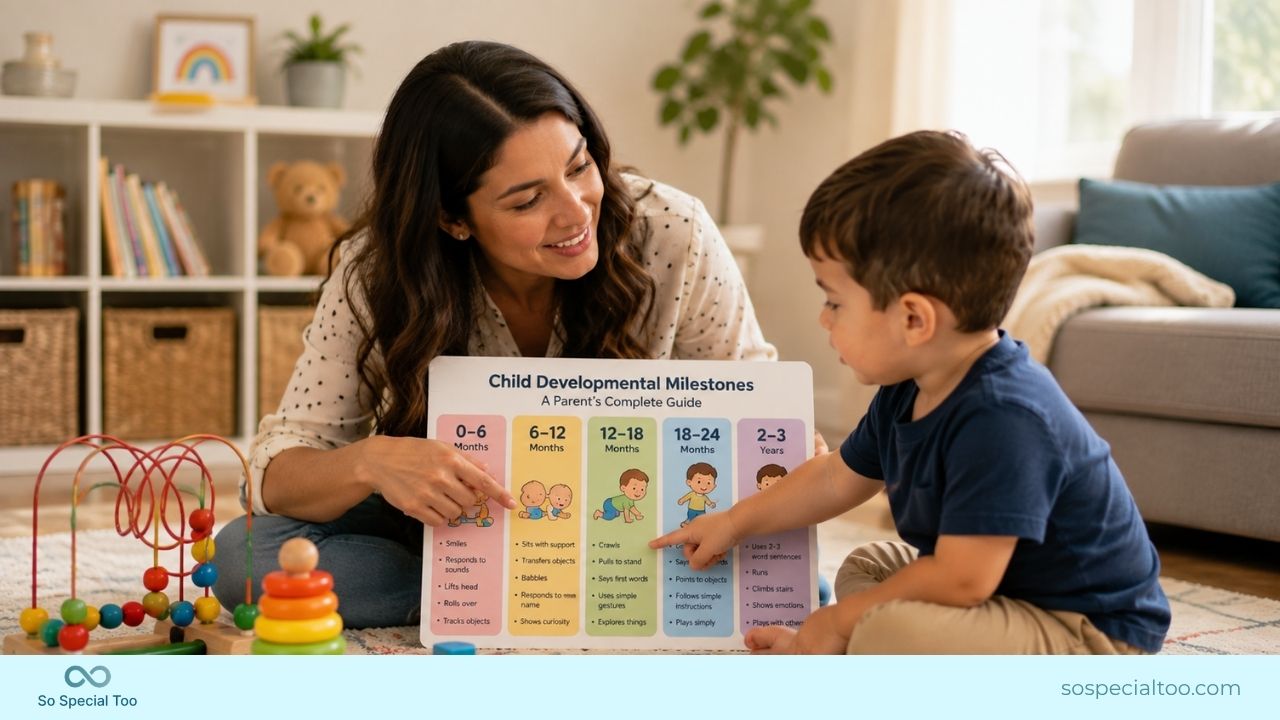
Child developmental milestones are skills and behaviors that most children develop within a general age range. They include smiling, sitting, walking, speaking, playing with others, following directions, solving simple problems, and becoming more independent.
Milestones help parents understand how a child is progressing physically, socially, emotionally, cognitively, and through language. They also give families, teachers, caregivers, and healthcare professionals a shared way to discuss development.
Every child develops at an individual pace. A child may gain some skills earlier than expected and need more time with others. Milestone guides are not tests, and one missed skill does not automatically mean that a child has a developmental delay or disorder.
But patterns matter! Parents should pay attention when progress slows, several skills are missing, communication or movement difficulties affect daily life, or a child loses abilities they previously used.
Key Takeaways
Developmental milestones can help parents notice progress, identify possible concerns, and prepare useful questions for well-child appointments.
- Development includes physical, language, cognitive, social, emotional, and self-help skills.
- Milestone ages are guides rather than exact deadlines for every child.
- Parents should look for ongoing progress across several developmental areas instead of focusing on one isolated skill.
- Developmental monitoring happens during everyday life, while developmental screening uses a formal, validated tool.
- A screening result is not a diagnosis.
- A child who loses previously acquired skills should be evaluated promptly.
- Early evaluation does not automatically mean that a child has a developmental disorder.
What Are Child Developmental Milestones?
Developmental milestones are observable skills that emerge as a child’s brain, body, communication abilities, and relationships develop. A baby looking toward a parent’s face, a toddler combining words, and a preschooler taking turns during a game are all examples.
Milestones are commonly grouped into several broad areas. Looking at these areas together provides a fuller picture than focusing only on speech, walking, or academic skills.
Physical and Motor Development
Physical development includes gross motor skills involving larger body movements and fine motor skills involving smaller, more precise movements.
Gross motor development begins with skills such as holding the head up, rolling, sitting, crawling, and pulling to stand. As children grow, they typically begin walking, running, jumping, climbing stairs, and balancing on one foot.
Fine motor development involves reaching for objects, transferring items between the hands, picking up small objects, stacking blocks, using a spoon, turning book pages, drawing, using child-safe scissors, and managing clothing fasteners.
Motor development affects more than movement. Reaching, crawling, walking, and using the hands allow children to explore objects, participate in play, complete everyday routines, and become more independent.
Language and Communication Development
Communication begins before a child says their first word. Babies communicate through crying, facial expressions, body movements, sounds, eye contact, gestures, and shared attention.
As communication develops, children may begin babbling, responding to voices, looking when their name is called, pointing, waving, and using first words. Later skills include combining words, following directions, asking questions, telling simple stories, and participating in conversations.
Language includes receptive and expressive skills. Receptive language refers to what a child understands, while expressive language refers to how a child communicates thoughts, needs, feelings, and experiences.
A child may understand more than they can say. Another child may speak frequently while having difficulty understanding questions or directions. Both receptive and expressive language should be considered when reviewing development.
Cognitive Development
Cognitive development refers to learning, attention, memory, reasoning, imagination, and problem-solving.
During infancy, cognitive skills may include watching a moving object, searching for a hidden toy, and exploring objects with the hands and mouth. As children grow, they may begin to understand how simple toys work, match shapes, follow routines, engage in pretend play, sort objects, count, and remember parts of a story.
Everyday activities give children opportunities to develop these skills. Reading, talking, sorting laundry, stacking blocks, completing puzzles, singing counting songs, and exploring safe household objects can all support learning.
Social and Emotional Development
Social and emotional development includes forming relationships, expressing emotions, responding to other people, managing frustration, playing with peers, and gradually becoming more independent.
Early social and emotional milestones may include looking at familiar faces, smiling at caregivers, enjoying interaction, seeking comfort, showing different emotions, and checking that a caregiver is nearby.
As children grow, they may begin sharing, taking turns, joining group play, following simple rules, comforting others, and helping with household tasks.
Social development does not look identical in every child. Temperament, communication ability, sensory preferences, familiarity with the setting, and previous experiences can influence how a child interacts.
Child Developmental Milestones by Age
The CDC’s developmental milestone resources organize selected skills from 2 months through age 5 across movement, communication, learning, and social development.
The following chart offers a general overview for developmental monitoring. It is not a diagnostic tool and does not include every skill a child may develop at each age.
| Age | Physical and Motor Skills | Language and Communication | Cognitive Skills | Social and Emotional Skills |
| 2 months | Holds head up briefly during tummy time and moves both arms and legs | Makes sounds other than crying and reacts to loud sounds | Watches a caregiver move and looks at a toy briefly | Looks at faces, calms when comforted, and begins smiling socially |
| 4 months | Holds head steady, brings hands to mouth, and pushes up on forearms | Makes cooing sounds and responds to voices | Opens mouth when seeing a breast or bottle if hungry and watches their hands | Smiles to gain attention, chuckles, and seeks interaction |
| 6 months | Rolls from tummy to back and supports weight with hands while sitting | Takes turns making sounds, squeals, and blows raspberries | Reaches for a desired toy and explores objects with the mouth | Recognizes familiar people, laughs, and enjoys looking in a mirror |
| 9 months | Sits without support, moves objects between hands, and rakes food with fingers | Makes repeated sounds and looks when their name is called | Searches for dropped objects and bangs objects together | May react when a caregiver leaves and shows several facial expressions |
| 12 months | Pulls to stand, walks while holding furniture, and picks up food using the thumb and finger | Waves, understands “no,” and uses names such as “mama” or “dada” | Places an object into a container and searches for hidden objects | Plays simple social games, shows affection, and may be cautious around strangers |
| 15 months | Takes a few independent steps and finger-feeds | Attempts one or two words besides parent names and points to request help | Uses familiar objects appropriately and stacks two small objects | Copies other children, shows affection, and displays preferred objects |
| 18 months | Walks independently, scribbles, and climbs on and off furniture | Attempts several words and follows a one-step direction without a gesture | Copies simple chores and plays with toys in basic ways | Moves away but checks that a caregiver is nearby and points out interesting things |
| 2 years | Runs, kicks a ball, walks up several stairs, and eats with a spoon | Combines at least two words and points to named body parts | Uses switches or buttons on toys and plays with more than one toy at once | Notices when others are upset and looks to a caregiver in unfamiliar situations |
| 30 months | Jumps with both feet, twists lids or handles, and turns pages individually | Uses about 50 words, combines action words and nouns, and follows two-step directions | Uses pretend play, follows simple routines, and recognizes a basic color | Plays beside and sometimes with other children and follows simple routines |
| 3 years | Uses a fork, strings large items, and puts on some clothing | Participates in short conversations, asks questions, and states their first name | Draws a circle after a demonstration and avoids a hot object after a warning | Notices other children, joins play, and separates from caregivers more easily |
| 4 years | Catches a large ball, holds a crayon with fingers, and unbuttons some buttons | Uses sentences of four or more words and discusses something that happened | Names colors, predicts what comes next in a familiar story, and draws a person with several parts | Engages in pretend roles, comforts others, and adjusts behavior to the setting |
| 5 years | Hops on one foot and buttons some buttons | Tells a story with at least two events, continues a conversation, and recognizes rhymes | Counts to 10, names some letters and numbers, and pays attention during an activity | Takes turns during games, follows simple rules, and completes basic household tasks |
Parents can use milestone checklists to notice new skills and prepare for conversations with a pediatrician. They should not use the chart to compare children competitively or diagnose a condition at home.
Do All Children Reach Milestones at the Same Age?
Children do not develop according to identical timelines. One child may walk early but begin speaking later. Another may have an advanced vocabulary while needing more time to develop balance, coordination, or independence.
Development may be influenced by temperament, opportunities for movement and play, hearing, vision, general health, premature birth, genetics, medical conditions, family interactions, language exposure, and environmental experiences.
A small difference in one area does not necessarily mean that a child has a developmental delay. Parents should consider whether the child continues learning new skills and making progress over time.
Children born prematurely may sometimes be assessed using corrected age during early development. Corrected age is based on the child’s original due date rather than only the birth date. A pediatrician can explain how long corrected age should be considered for an individual child.
Parents should also avoid interpreting milestone differences without considering the child’s complete situation. A child who uses more than one language may distribute vocabulary across languages. A child who is cautious in unfamiliar places may not demonstrate the same social skills during a brief appointment that they use at home.
Developmental Monitoring and Developmental Screening
Developmental monitoring and developmental screening both help identify potential concerns, but they are not the same process. Monitoring is ongoing and informal, while screening uses a structured tool.
The CDC’s explanation of developmental monitoring and developmental screening describes how the two processes work together to help families and professionals recognize when further evaluation may be appropriate.
Developmental Monitoring
Developmental monitoring is the ongoing process of observing how a child plays, learns, communicates, behaves, and moves.
Parents, caregivers, childcare professionals, teachers, and healthcare providers can all participate. Monitoring happens during normal activities rather than through a single test.
Parents can keep brief notes about new skills, complete age-based checklists, save examples of drawings or writing, record communication changes, and ask teachers or caregivers what they observe. These details can then be discussed during well-child visits.
Monitoring should include strengths as well as concerns. Noticing what a child can do helps parents recognize progress and provide useful information during appointments.
Developmental Screening
Developmental screening is a more formal assessment completed with a validated questionnaire or screening tool. It may evaluate language, movement, problem-solving, behavior, and social-emotional development.
The American Academy of Pediatrics recommends general developmental screening during regular well-child visits at 9 months, 18 months, and 30 months. Autism-specific screening is recommended at 18 months and 24 months.
Screening may also be appropriate at any age when a parent, caregiver, teacher, or healthcare provider has a concern.
A screening result is not a diagnosis. It indicates whether the child may benefit from a more detailed developmental, medical, hearing, vision, speech-language, occupational therapy, or educational evaluation.
Parents can ask their child’s healthcare provider which screening tool is being used, what the result means, and what next steps are recommended.
How Can Parents Support Healthy Child Development?
Parents do not need expensive educational programs or a packed activity schedule to support development. Responsive, consistent interactions during everyday routines provide meaningful opportunities for children to learn.
Activities should be enjoyable, appropriate for the child’s abilities, and flexible enough to follow the child’s interests.
Talk and Respond Throughout the Day
Describe what the child is seeing and doing. Respond to sounds, gestures, words, and questions. Pause during conversations to give the child time to respond.
For babies, imitate coos, smiles, and facial expressions. For toddlers, expand short statements. If a child says, “Big dog,” a parent might reply, “Yes, that is a big brown dog.”
Communication does not need to involve constant questioning. Comments, descriptions, gestures, songs, and shared attention can be just as valuable.
Read Together Regularly
Reading supports language, attention, memory, imagination, and emotional connection.
Babies can look at pictures and listen to a caregiver’s voice. Toddlers can point to familiar objects, make sounds, and turn pages. Preschoolers can answer simple questions, retell events, and predict what may happen next.
Parents might ask what the child sees, how a character feels, what happened first, or what may happen next. They can also name pictures, make sound effects, and connect the story to the child’s own experiences.
Parents do not need to finish every book. Repeating favorite stories, discussing pictures, and allowing the child to participate can make reading more engaging.
Encourage Safe Movement
Supervised floor play gives babies opportunities to reach, roll, turn, and strengthen their bodies.
Toddlers may benefit from walking, climbing safely, throwing soft balls, dancing, and pushing or pulling toys. Preschool children can practice hopping, balancing, pedaling, drawing, and using child-safe scissors.
Movement activities should match the child’s developmental abilities and be supervised appropriately. Children should not be pressured to perform a movement that causes fear, pain, or unusual difficulty.
Use Play as a Learning Tool
Play helps children practice communication, movement, creativity, decision-making, emotional regulation, and social skills.
Blocks, containers, dolls, pretend food, puzzles, crayons, balls, toy vehicles, dress-up items, and safe household objects can all support development.
Follow the child’s interests and allow time for exploration. A parent can add language, demonstrate a new action, or introduce a simple idea without controlling every part of the activity.
Pretend play can support sequencing and flexible thinking. A child might feed a doll, put a toy animal to sleep, prepare pretend food, or act out a familiar family routine.
Create Predictable Routines
Regular routines around meals, sleep, play, bathing, and transitions help children understand what to expect.
Predictability can support emotional regulation, cooperation, communication, and independence. Visual reminders, songs, and repeated phrases may make transitions easier for some children.
Simple responsibilities can also build confidence. A toddler may place a toy in a basket, while a preschooler may match socks, carry napkins to the table, or help put away groceries.
Support Social and Emotional Skills
Name emotions calmly and connect feelings with experiences. Statements such as “You are frustrated because the tower fell” help children develop emotional vocabulary.
Comfort children when they are upset while gradually teaching age-appropriate coping strategies. Parents can model breathing slowly, asking for help, taking a break, or trying again.
Turn-taking, patience, and problem-solving develop over time. Adults can demonstrate these skills during family interactions instead of expecting children to manage strong emotions independently.
Parents who are exploring the relationship between developmental patterns and autism can read So Special Too’s guide to early milestones and autism.
When Should Parents Be Concerned About Development?
One missed item on a checklist does not confirm a developmental condition. However, parents should discuss ongoing concerns rather than waiting indefinitely for a child to catch up.
The American Academy of Pediatrics advises families who are worried about a child’s development to speak with the child’s doctor and request screening or further evaluation when appropriate.
Contact a pediatrician or another qualified healthcare professional when a child:
- Loses a skill they previously used
- Does not respond consistently to sounds or their name
- Rarely uses gestures, sounds, words, or other methods to communicate
- Has difficulty moving one side of the body
- Appears unusually stiff or unusually floppy
- Has difficulty eating, chewing, or swallowing
- Shows possible hearing or vision difficulties
- Makes little developmental progress over time
- Is missing several expected skills in one or more areas
- Experiences behavior or communication difficulties that significantly affect everyday participation
Skill loss deserves prompt medical attention. Developmental regression can have different causes and should not be evaluated through an online checklist alone.
Parents do not need to wait for a routine appointment when they are concerned. They can write down what they have noticed, collect examples, ask teachers or caregivers for observations, and request a developmental screening.
Depending on the concern, a child may be referred for hearing testing, vision testing, speech-language evaluation, occupational therapy, physical therapy, developmental assessment, psychological evaluation, or early intervention services.
Families looking for personalized guidance can explore So Special Too’s consultation, therapy, and family support services. Appropriate support should be based on the child’s individual strengths, needs, and professional evaluation results.
FAQs
What Are the Main Areas of Child Development?
The main areas include physical and motor development, language and communication, cognitive development, and social-emotional development. Daily living and self-help skills, such as feeding, dressing, toileting, and completing simple tasks, are also important.
Development should be considered across all areas because skills often influence one another. Movement allows exploration, communication supports relationships, and emotional regulation helps children participate in learning.
How Late Can a Child Reach a Milestone and Still Be Developing Normally?
There is no single grace period that applies to every milestone or every child. Some variation is expected, especially when a child continues making steady progress.
Parents should speak with a pediatrician when a child misses several age-related skills, stops gaining new abilities, struggles to participate in everyday routines, or loses a previously acquired skill.
Does a Developmental Delay Mean a Child Has Autism?
No. Developmental delays can affect speech, movement, learning, behavior, self-help skills, or social interaction and can have many possible explanations.
Autism is one possible developmental condition, but a milestone checklist cannot diagnose it. A qualified professional must consider the child’s developmental history, communication, behavior, play, social interaction, sensory responses, and other relevant information.
Should Parents Correct a Premature Baby’s Age When Checking Milestones?
Corrected age is often used during early development for babies born prematurely. It is calculated from the child’s expected due date rather than only the date of birth.
A pediatrician can explain whether corrected age should be used, how it is calculated, and how long it remains relevant for the child.
Can Children Catch Up After a Developmental Delay?
Some children make progress and catch up without long-term intervention. Others benefit from speech therapy, occupational therapy, physical therapy, educational services, behavioral support, or other individualized interventions.
The outcome depends on the child, the developmental area involved, the cause of the delay, and the type of support needed. Early evaluation helps families understand the available options without assuming a particular diagnosis.
Final Thoughts
Developmental milestones help parents understand how a child is growing, learning, moving, communicating, and connecting with others. They should be used as flexible guides rather than strict deadlines or measures of a child’s intelligence and potential.
Parents can support development through responsive conversation, shared reading, safe movement, play, predictable routines, and emotional connection. Monitoring progress across several areas provides a clearer picture than focusing on one isolated skill.
When progress slows, several milestones are missing, daily participation becomes difficult, or a child loses a skill, parents should discuss their observations with a pediatrician. Early screening and evaluation can clarify whether the child needs continued monitoring, practical home strategies, specialist assessment, or developmental support.




