
 By Walker Evans

Every parent who starts looking into an autism diagnosis usually begins in the same place: a quiet worry that something isn’t lining up, mixed with a lot of questions and pressure to “do it right.” The helpful truth is that autism diagnosis isn’t a single test. It’s a structured clinical process that combines your child’s developmental history, real-life functioning, and professional observation, often supported by standardized diagnostic tools.
This guide walks you through the step-by-step process, from initial concerns to a clear outcome, so you know what to expect and how to prepare.
Key Takeaways
- Autism diagnosis is a multi-step clinical evaluation, not a single test.
- Screening tools can suggest “next steps,” but they do not confirm a diagnosis.
- A strong assessment combines parent history, direct observation, and standardized measures.
- Preparation (records, examples, context) helps make results more accurate and useful.
- A diagnosis should come with practical recommendations for home, school, and therapy planning.
When Parents First Suspect Autism, What Should Happen Next?
This phase isn’t about proving anything. It’s about recognizing patterns and choosing the right professional pathway, without wasting months on guesswork.
Many families begin with a conversation during a well-child visit, where the provider may use screening tools and refer for a diagnostic evaluation if needed. The CDC describes diagnosis as a step-by-step process based on developmental history and behavior.
Begin with patterns, not comparisons
Instead of comparing your child to siblings or classmates, focus on what you’re noticing repeatedly across daily routines: play, social connection, communication, flexibility, and sensory reactions.
A practical way to organize your observations is to think in three buckets:
- Social connection includes how your child engages in back-and-forth interaction, shares attention, or responds to their name in everyday situations.
- Communication includes how they express needs, how they understand language, and whether speech (or nonverbal communication) is used socially, not just functionally.
- Behaviors and regulatory issues include repetitive play patterns, distress during transitions, intense routines, and sensory responses that affect daily life.
If you want a clearer boundary between “screening tools” and “diagnostic tools,” So Special Too breaks it down well here: AQ vs. Clinical Diagnostic Tools: Key Differences Explained
Talk to a provider who can guide the referral
Your primary provider can refer you to professionals who regularly diagnose autism (developmental clinicians, psychologists, psychiatrists). The Mayo Clinic notes that when autism is suspected, children are often referred to specialists for evaluation.
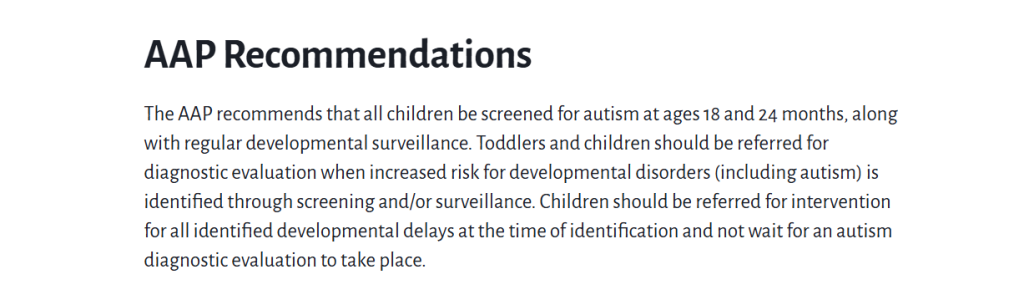
Screening flags potential risk and guides next steps. Diagnosis is a formal clinical decision. The AAP encourages screening at 18 and 24 months and referral when risk is identified.
The Autism Diagnosis Process Step by Step
Here’s the full “map” to help you picture what usually happens in an autism diagnosis pathway.
Most comprehensive evaluations follow a similar structure: intake, record review, parent interview, direct observation, additional testing (when needed), then a diagnostic decision and written report.
Autism Diagnosis Timeline at a Glance
| Step | Who is involved | What happens | What you get |
| 1) Referral or intake | Primary care provider or clinic intake team | You share concerns, history, and complete forms | Appointment plan + questionnaires |
| 2) Record gathering | Parents/caregivers + clinic | You provide medical, school, therapy, and developmental records | Context that supports accuracy |
| 3) Parent interview | Psychologist / developmental clinician | Detailed developmental history interview | A documented narrative used in diagnosis |
| 4) Direct observation | Trained clinician | Structured activities + interaction-based observation | Observational findings and scoring (if standardized tool used) |
| 5) Additional assessments (as needed) | Speech/OT/psych or multidisciplinary team | Language, cognition, adaptive skills, sensory profile | A strengths/needs profile |
| 6) Diagnostic decision | Qualified diagnostician/team | Clinicians integrate data with diagnostic criteria | Diagnostic outcome |
| 7) Written report + feedback | Diagnostician/team + parents | Results meeting + practical recommendations | Report for school, services, accommodations |
Step 1: Intake and Pre-Assessment Questionnaires
Before you meet the assessment team, most clinics ask you to complete intake forms. These questionnaires help clinicians understand your child’s daily functioning, development, and areas of concern. Parents sometimes worry about answering “correctly,” but the goal is not perfect wording. The goal is an honest picture of what happens on most days.
A simple way to approach it is to answer based on your child’s typical week, not their best or hardest moments. The more consistent your picture is, the easier it is for the clinician to interpret what they observe during the evaluation.
Step 2: Records and Real-Life Examples That Improve Accuracy
Records do not replace evaluation, but they provide essential context. Autism diagnosis is based on developmental history and observable patterns. A clinic visit is a brief snapshot, and records show the broader story.
Instead of building a long list, think of records as a few practical categories that help the clinician understand your child across time and settings.
Medical and developmental background
Birth history notes, early medical records, hearing and vision screening results, and relevant specialist visits can help clinicians rule out other explanations for communication and behavior differences.
School and learning context
If your child is in daycare, preschool, or school, teacher observations and learning plans can show how your child functions outside the home. Autism-related needs sometimes appear differently in structured environments, especially during group activities, transitions, or demands that require flexibility.
Therapy reports and progress notes
If your child receives speech therapy, occupational therapy, or behavioral supports, prior evaluations can reveal patterns and strengths relevant to diagnosis. These reports also help translate concerns into practical support in the future.
Some parents also bring short videos from home. When used thoughtfully, videos can capture everyday behavior that may not be observed in a clinic setting, especially if your child responds differently in unfamiliar environments.
Step 3: The Parent or Caregiver Developmental History Interview
This interview is often one of the most important parts of the autism diagnosis process. It is where the clinician learns about your child’s early development, communication, social interests, play style, routines, and sensory needs over time.
You may be asked about early milestones and specific behaviors, but the clinician is not looking for a single definitive sign. They are looking for a pattern that fits how autism is clinically defined, while considering your child’s age and developmental level.
If you feel emotional during this part, that is normal. Many parents experience relief and grief at the same time. Relief comes from finally being taken seriously. Grief can come from realizing how hard things have been. A skilled clinician expects this and supports you through it.
Step 4: Direct Observation and Diagnostic-Quality Assessment Tools
This part is what many parents imagine as the test, but it often looks like guided play, conversation, or structured activities. The clinician may use standardized diagnostic tools rather than casual screening.
During observation, the clinician typically assesses how your child communicates, connects socially, manages attentional shifts, and responds to change. They may also note repetitive behaviors or sensory patterns. Clinicians interpret what they see through the lens of developmental level and emotional state. A shy, anxious, or exhausted child may behave differently in the clinic than at home.
This is one reason autism diagnosis relies on multiple sources. What happens in the room is important, but it is only one part of the full picture. If you want a parent-friendly explanation of what an autism screening/assessment appointment can involve, the Cleveland Clinic has a simple overview of typical components (interviews, questionnaires, observation).
Who Can Diagnose Autism, and What Clinicians Look For?
Autism is typically diagnosed by professionals trained to make clinical diagnostic decisions. This often includes developmental pediatricians, clinical psychologists, or psychiatrists, sometimes as part of a multidisciplinary team. The most important factor is experience with autism diagnosis across different ages and presentations.
In plain language, clinicians usually answer four questions:
- Social communication: Does your child show consistent differences in how they connect, share attention, and use communication socially?
- Repetitive patterns: Are there restricted or repetitive behaviors, strong routines, intense interests, or sensory-related patterns?
- Developmental history: Have these patterns been present since early development, even if they became more obvious later?
- Daily impact: Do these differences affect day-to-day functioning at home, in learning environments, socially, or in independence skills?
Clinicians also consider overlap and co-occurring conditions. Many children are autistic and also have ADHD or anxiety. Some children have language disorders that can resemble autism at first glance. A thorough process helps clarify the situation rather than relying on guesswork.
Additional Testing That Often Supports Autism Diagnosis
Some children only need the core diagnostic evaluation. Others benefit from additional assessments that explain how they learn, communicate, and function in daily life. These additions often turn the report into a plan that can guide school supports and therapy goals.
Language and communication assessment
If speech and language are part of your concerns, a clinician may recommend deeper evaluation of receptive language, expressive language, and social-pragmatic language, which is how language is used in real-world social situations.
Occupational therapy and sensory profile
If sensory needs are prominent, such as strong reactions to sound or touch, seeking pressure or movement, or challenges with motor planning, an occupational therapy assessment can add practical strategies for daily routines and regulation.
Cognitive and learning profile
When learning differences are suspected, cognitive testing may help explain thinking style, processing speed, problem-solving strengths, and areas that need support. This can be useful for school planning and accommodations.
Adaptive functioning and independence skills
Adaptive measures focus on everyday life skills like dressing, eating, toileting, transitions, flexibility, and safety awareness. These areas often matter more than test scores when building real-world support plans.

Public vs. Private Pathways: What Parents Should Consider?
In some regions, families must choose between public and private autism assessments. Public pathways can reduce out-of-pocket costs but may involve long wait times. Private pathways can offer faster access and more flexible scheduling, but they often require payment.
If your child is struggling at school, experiencing significant daily distress, or you feel early support would make a meaningful difference, the timeline becomes part of the decision. Some families pursue a private assessment to get clarity sooner while still using public systems for longer-term supports.
What Happens After the Autism Diagnosis Report Is Written?
The report is not the finish line. It is the starting point for support.
A thorough report usually includes a clear explanation of the findings, the diagnostic decision, and actionable recommendations. You should walk away knowing what to do next at home, what to request at school, and which supports may help.
What should a strong report give you?
A helpful autism diagnosis report typically answers three practical questions:
- What are your child’s strengths? Strengths guide goal-setting and help you advocate with confidence.
- What is making life harder right now? The report should explain challenges in understandable terms, such as communication breakdowns, sensory overwhelm, rigidity, anxiety, or social misunderstandings, without blaming the child.
- What supports fit your child today? Recommendations should be specific enough to act on. This might include therapy types, school accommodations, sensory strategies, communication supports, or parenting tools that reduce daily conflict.
If the report feels technical and not actionable, it is reasonable to ask for a clearer explanation. You are not bothering anyone. You are trying to help your child.
Next Step: Book an Autism Assessment Consultation
If you are exploring an autism diagnosis, one helpful step is to speak with a team that can explain the process clearly, outline the documentation required, and outline what a comprehensive assessment includes. Families can also explore autism assessment resources and reach out to discuss the next best step for their situation.
FAQs
Autism can be diagnosed in early childhood when symptoms are clear, and it can also be diagnosed later when social demands increase and differences become more noticeable. Age alone is not the deciding factor. The deciding factor is whether the full pattern fits clinical criteria and impacts daily functioning.
Some clinics complete the evaluation in one longer session, while others use multiple sessions, especially if additional speech, occupational therapy, or cognitive testing is needed. The number of visits often depends on age, language level, and complexity of needs.
Yes, and autism can also occur alongside anxiety and ADHD. That is why a comprehensive process considers developmental history, behavioral patterns, and functioning across settings rather than relying on a single questionnaire.
Even without an autism diagnosis, a good evaluation should identify needs and recommend supports. Many children benefit from communication support, occupational therapy strategies, or school accommodations regardless of the final label.
Keep it simple. Let them know they will meet someone who wants to learn how they communicate and play. If your child is anxious, bring a comfort item and plan a calm schedule before and after the appointment.
Conclusion
An autism diagnosis can feel heavy at first, but the process is designed to bring clarity, not judgment. A thorough evaluation helps you understand how your child experiences the world, where everyday life becomes challenging, and which supports can make things smoother at home and at school.If you are ready to move from uncertainty to a clear plan, explore our assessment resources and reach out to a specialist to discuss the next step for your family.




