
 By Walker Evans

Speech delay and autism are connected, but they are not the same thing. A child who speaks later than expected may simply have a language delay, or they may have autism, hearing loss, an oral-motor issue, or another developmental difference. The real question is not just, “Is the child talking yet?” but “How is the child communicating overall?” That is why doctors look at speech, gestures, eye contact, social interest, and play together instead of judging speech in isolation.
For parents, the most useful approach is to treat speech delay as a signal to pay attention, not as a diagnosis. Children develop at different speeds, and some late talkers catch up naturally, especially when language understanding is otherwise on track. At the same time, speech delay can be one of the early signs that leads clinicians to investigate autism more closely. The goal is not to panic; the goal is to notice patterns early enough to get help if it is needed.
Key Takeaways
- Speech delay can be an early sign of autism, but it does not automatically mean a child is autistic.
- Autism usually affects more than speech alone; it often also affects social communication, eye contact, gestures, and play.
- Some children have isolated late language emergence without autism or any other developmental condition.
- Hearing problems, oral-motor issues, and other developmental differences can also cause delayed speech.
- Early evaluation matters because support is most effective when concerns are addressed quickly.
- If you are worried, a pediatrician, hearing specialist, and speech-language pathologist can help identify the cause.
How Speech Delay and Autism Overlap
The overlap exists because many autistic children show delays in spoken language, but autism also involves differences in social communication and interaction. The CDC notes that people with ASD often have problems with social communication and interaction as well as restricted or repetitive behaviors or interests. In young children, that can show up as less pointing, less shared attention, less response to name, limited gestures, or reduced interest in back-and-forth interaction.
This matters because a child can have speech delay without autism, and a child can have autism without a major speech delay at first. Some autistic children use words, but use them in unusual ways, such as labeling objects without using language for sharing, asking, or conversation. Others may lose words they once used, which can be a regression pattern that warrants prompt attention. The point is that the pattern of communication is often more informative than the number of words alone.
What Counts as a Delay?
Developmental milestones give you a useful baseline. By 18 months, the CDC says many children try to say three or more words besides “mama” or “dada,” and they follow one-step directions without gestures. By 24 months, many children are using more words and beginning to combine language in increasingly meaningful ways.
The most important difference is whether the child is only delayed in spoken words or also delayed in the social use of communication. A child who understands language, points, imitates, shares interest, and responds to others differently from one who does not. That is why clinicians pay attention to gestures, eye contact, turn-taking, pretend play, and response to name, not just vocabulary counts.
Speech Delay Is Not Always Autism
This is the point many parents need most: speech delay can happen for many reasons besides autism. Research indicates that late language emergence is language delay without other diagnosed disabilities or developmental delays in other cognitive or motor areas. In other words, some children are simply late talkers. Some children also have mixed expressive and receptive delays, meaning they struggle both to speak and to understand language.
According to the guide written by Nemours KidsHealth, delayed speech may come from oral-motor problems, hearing problems, or other developmental issues.
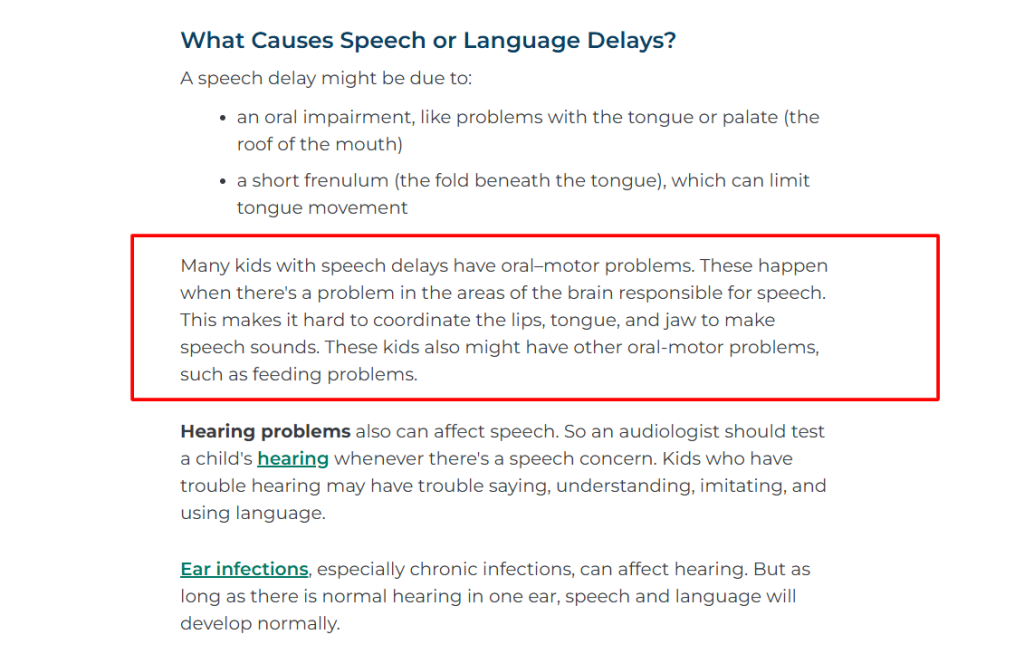
This is also why it is risky to assume that every late talker is autistic. A language delay can be isolated, temporary, or linked to another condition entirely. Autism is one possible explanation, but it is not the only one, and responsible evaluation keeps that distinction clear.
Speech Delay vs. Autism-Related Communication Concerns
| Area | More consistent with isolated speech delay | More concerning for autism-related differences |
| Spoken words | Fewer words than expected | Fewer words plus unusual use of words |
| Eye contact | Usually present | Often reduced or inconsistent |
| Gestures | Often used to communicate | Often fewer gestures, especially pointing/waving |
| Shared attention | Child tries to share interest | Child may not look back and forth between object and person |
| Response to name | Usually present if hearing is normal | May be reduced or absent |
| Play | Age-appropriate imitation or pretend play may still be present | Pretend play and social play may be delayed or different |
| Communication style | Child wants to communicate, even if words are limited | Child may label or repeat words without using them socially |
This chart is not a diagnostic tool, but it helps organize what to watch for. The most important clue is whether the child is only late in speech or also different in social communication. If the second pattern is present, the possibility of autism becomes more important to investigate.
Signs That Need a Closer Look
The CDC lists several early autism signs that are especially relevant when speech is delayed: not responding to name by 9 months, few or no gestures by 12 months, not pointing to show interest by 18 months, and not noticing or joining other children in play by 36 months. A child who once seemed to be progressing and then stops gaining skills deserves prompt evaluation.
The experts at Mayo Clinic describe autism as involving communication challenges along with social and behavioral differences. Their symptoms page notes delayed speech, trouble starting or maintaining conversation, unusual tone or rhythm, and limited sharing of interests. Those patterns are more suggestive of autism than speech delay alone because they point to a broader communication profile, not just fewer spoken words.
Why Early Action Matters
Concerns about speech should never be brushed aside with a “wait and see” approach that lasts too long. The CDC says ASD begins before age 3, and some children show symptoms in the first 12 months, while others are noticed later around 18 to 24 months.
That does not mean every child needs an autism label. It means every significant language concern deserves a proper developmental check.
Pediatricians often recommend autism screening at 18 and 24 months, and they may also refer families for hearing evaluation and speech-language assessment. The earlier support begins, the more room there is to build communication skills during the most responsive developmental window.
What Help Usually Looks Like
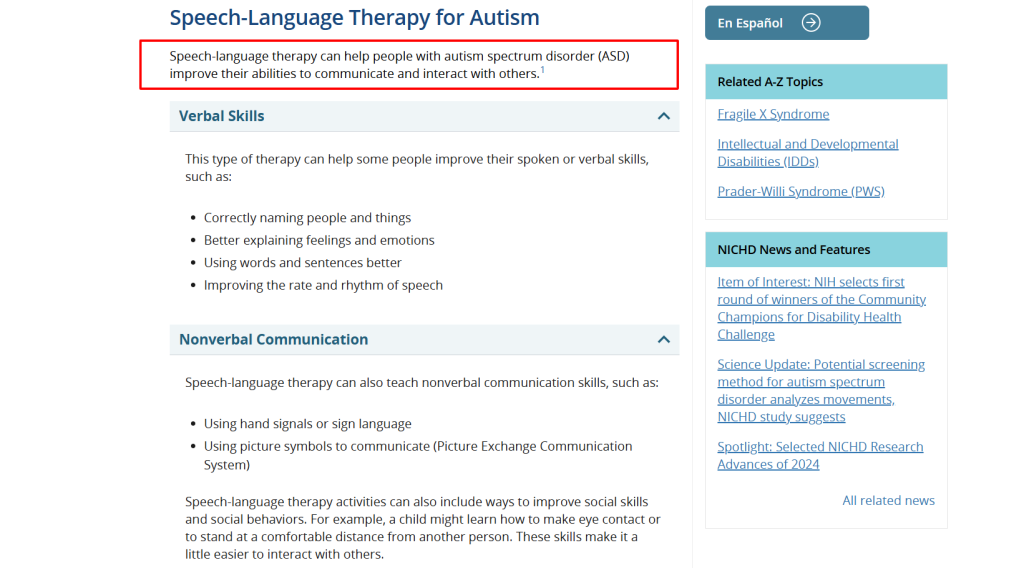
When speech delay is the main concern, a speech-language pathologist can evaluate both expressive and receptive language, speech clarity, and oral-motor skills. KidsHealth explains that the SLP checks what the child understands, what the child can say, and how the mouth and tongue work together for speech. If autism is part of the picture, speech-language therapy may still be central because it can improve verbal and nonverbal communication, social skills, and practical interaction.
The researchers at the NICHD explain that Speech-language therapy can support spoken language, nonverbal communication, and skills such as eye contact and comfortable social distance.
The best results usually come from early, individualized support rather than a one-size-fits-all approach. Some children need hearing care first. Some need speech therapy. Some need developmental evaluation. Some need all three. A thoughtful assessment separates the cause from the symptom so the child gets the right kind of help.
What Parents Can Watch for at Home
At home, the question is not only whether your child talks, but whether they are communicating in flexible, connected ways. Are they pointing to share interest, looking back at you to see your reaction, imitating simple actions, or trying to get your attention with gestures?
Do they respond to their name, enjoy simple games, or show interest in people as well as objects? These are the kinds of behaviors that help distinguish isolated speech delay from a broader social communication pattern.
If your child uses very few words, that alone does not tell the whole story. Watch the context around communication. A child who is frustrated but engaged is different from a child who seems socially disconnected, rarely points, and does not respond to shared attention.
Those distinctions matter because they guide whether the next step is hearing testing, speech therapy, autism screening, or all of the above.

When to Seek Help
Seek evaluation sooner rather than later if your child is not meeting expected language milestones, has lost words or social skills, does not respond to name, rarely uses gestures, or seems unusually uninterested in interaction. Professionals recommend acting early, as it can still uncover a hearing issue, language disorder, or other treatable concern.
A practical first step is to speak with your pediatrician and ask whether a hearing assessment and speech-language evaluation are appropriate. If the child also shows social communication differences, ask about autism screening as well. The most helpful plan is the one that looks at the whole child, not just the speech delay.
FAQs
No. Speech delay can happen for many reasons, including hearing problems, oral-motor issues, or isolated late language emergence. Autism is one possible cause, but not the only one.
Autism-related speech delay usually comes with broader social communication differences, such as limited gestures, reduced eye contact, less joint attention, or unusual use of language.
A few words may still be within a normal range depending on age, but milestone comparison matters. If speech is behind expected age norms or other communication skills are delayed too, it is worth getting evaluated.
Yes. Some autistic children develop spoken language on schedule but still show differences in social communication, play, or flexibility. Speech alone does not rule autism in or out.
Start with a pediatrician visit and ask about hearing testing, speech-language evaluation, and autism screening if social communication concerns are also present.
Final Thoughts
Speech delay and autism can be connected, but they are not the same. While delayed speech may be an early sign of autism, it can also result from hearing loss, language disorders, or other developmental factors. Looking beyond spoken words to social communication, gestures, eye contact, and play provides a clearer picture.
If you have concerns about your child’s development, seeking an early evaluation can help identify the cause and ensure they receive the right support as soon as possible.




