
 By Walker Evans

If you’ve been searching for “types of autism,” you’re probably trying to answer a very normal parent question: What does this mean in real life? You might be a parent, caregiver, teacher, or family member who’s heard terms like Level 1, Level 2, Level 3, “high-functioning,” “severe,” or even older labels like Asperger’s.
This blog explains what autism levels actually refer to, why people still say “types,” and how clinicians describe support needs today. By the end, you’ll leave with a clearer understanding of autism’s levels, what they do (and don’t) tell you, and how to think about support without falling into confusing stereotypes.
Key Takeaways
- Autism is diagnosed as Autism Spectrum Disorder (ASD), and many people say “types of autism” when they’re really asking about support needs.
- Clinicians often describe ASD using Level 1 (requiring support), Level 2 (requiring substantial support), and Level 3 (requiring very substantial support).
- These levels are based on two core areas: social communication and restricted or repetitive behaviors and interests.
- A person’s support needs can look different depending on the setting, such as home, school, or public places.
- Autism levels are not personality labels, and they don’t capture every strength, challenge, or unique trait a person may have.
- The main purpose of levels is practical: to describe current support needs so services and accommodations can be matched more accurately.
Why do people say “types of autism” (and what the diagnosis means today)?
“Types of autism” is a common phrase, but clinically, autism is diagnosed under one umbrella: Autism Spectrum Disorder (ASD). That spectrum includes a wide range of communication styles, sensory experiences, strengths, and challenges.
The CDC describes ASD as a developmental disability linked to differences in the brain, often involving challenges with social communication and interaction and restricted or repetitive behaviors or interests.
In older systems, you may have seen separate labels like Asperger syndrome or PDD-NOS. Many people still use those terms casually or identify with them personally, but modern diagnostic systems group them under ASD and use more detailed descriptions (including levels and specifiers).
So, when someone asks “what type,” the best translation is usually: What does my child (or client) need support with, and how much support is required?
What do Autism Levels 1, 2, and 3 actually measure?
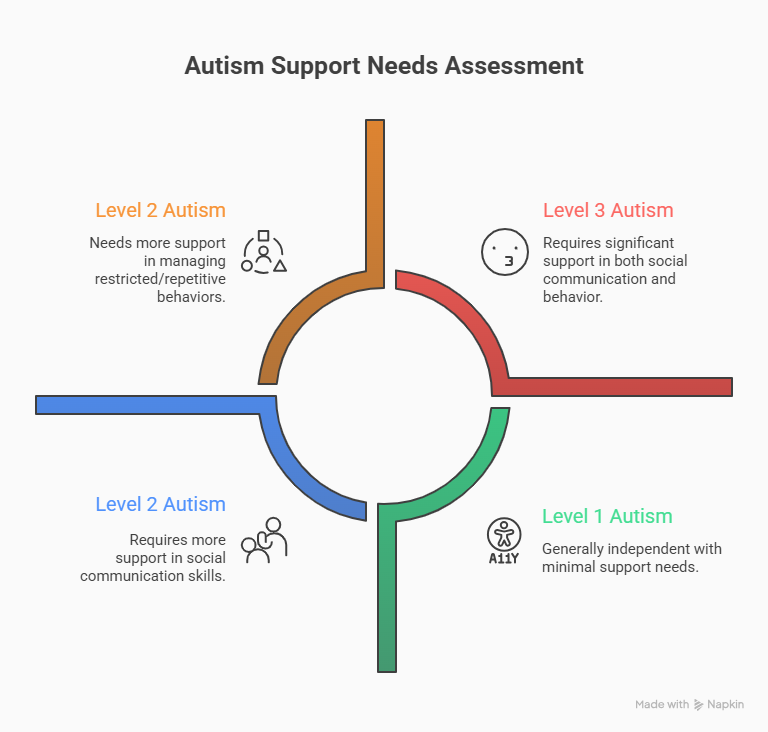
Autism “levels” are a way clinicians describe current support needs. They are typically based on difficulties in:
- Social communication (initiating interaction, back-and-forth conversation, using nonverbal communication, building relationships), and
- Restricted/repetitive behaviors (rigidity with routines, repetitive movements or speech, intense interests, sensory sensitivities). (CDC)
Here’s the important nuance: a person can sometimes look “Level 1-ish” in one area and “Level 2-ish” in another, depending on the situation and what supports are available. That’s why levels are best viewed as functional descriptions, not fixed identity tags.
Autism Level 1: Requiring Support
Level 1 often means a person can function with fewer supports than Levels 2 or 3, but without support, challenges become noticeable and can interfere with daily life.
Social communication profile
You may have difficulty initiating social interactions, experience uncertainty in back-and-forth conversations, or make social attempts that don’t land as intended. CHOP Research Institute suggests that some individuals appear “fine” in short interactions but struggle with friendships, group dynamics, or reading social cues consistently.
A key point: some people at Level 1 mask well, especially in structured environments, and then feel exhausted or dysregulated afterward.
Restricted/repetitive patterns
Rigid routines, strong preferences, and focused interests may be present. The person may have trouble shifting attention away from preferred topics or activities, especially under stress.
What often helps most at Level 1 is predictable structure, communication coaching, sensory strategies, and practical accommodations in school/work environments.
Autism Level 2: Requiring Substantial Support
Level 2 usually means differences are more apparent and support needs are more consistent across daily life.
Social communication profile
Individuals may have marked challenges with verbal and nonverbal communication. Initiating interaction can be difficult, and responses to others may seem limited, unusual, or mismatched to the situation. Even with support, social communication may remain a significant daily challenge.
Restricted/repetitive patterns
Repetitive behaviors, sensory distress, and rigidity can be more disruptive at this level. Changes in routine may trigger strong distress, and flexibility may require structured teaching and repeated practice.
Support at Level 2 often includes more intensive speech/communication supports, occupational therapy for sensory regulation, structured skills-building, and consistent accommodations across school and home.
Autism Level 3: Requiring Very Substantial Support
Level 3 indicates the highest level of support needs, as defined by the level system. This does not mean a lack of strengths. It means daily functioning may require consistent, significant support.
Social communication profile
Communication differences tend to be severe and may include very limited initiation of interaction and minimal response to social overtures. Some individuals may use a few words, use alternative communication methods, or communicate more through behavior and support tools.
The core priority here is often accessible communication because communication is a basic need, not a “nice-to-have.”
Restricted/repetitive patterns
Repetitive behaviors and sensory challenges may be intense and frequent, and rigidity may make transitions and daily changes very difficult. Support often involves highly structured environments, consistent routines, proactive sensory planning, and safety-focused strategies when needed.
A respectful reminder: Level 3 does not equal “no potential.” It simply describes the level of support required right now.
Why are “high-functioning” and “low-functioning” misleading?
Many families still hear “high-functioning” for Level 1 and “severe” for Level 3. The problem is that those words flatten the picture. Someone who speaks well may still struggle with sensory overload, anxiety, and daily functioning. Someone who speaks very little may still understand far more than people assume and may thrive with the proper support.
A better approach is to focus on support needs and access:
- What environments help this person function best?
- What triggers overload?
- What communication method is most reliable?
- What accommodations actually change daily life?
This is precisely why ASD levels are framed around support rather than “ability rankings.”
What “specifiers” add (the details that make the picture real)?
Beyond the level, clinicians may specify whether things like accompany autism:
- Intellectual impairment (or not)
- Language impairment (or not)
- Associated medical/genetic conditions
- Co-occurring conditions like ADHD or anxiety
These details matter because two people can both be “Level 2” and still have totally different needs depending on language abilities, learning profile, sensory needs, and co-occurring challenges.
How do clinicians decide the level?
Levels are usually determined through a comprehensive evaluation that includes developmental history, caregiver interviews, direct observation, and, when appropriate, structured tools. The CDC states that an ASD diagnosis is based on behavioral and developmental assessment, often involving specialists.
Also worth noting: levels can change as skills develop and supports improve, or as demands increase (for example, during school transitions, adolescence, ornew environments). The goal is not to “prove” a level; it’s to ensure supports match reality.
What can parents and caregivers do with this information?
If you’re trying to understand “types of autism,” use levels as a starting point, not the whole story. Ask professionals questions that lead to practical clarity:
- What support helps my child communicate best?
- What sensory factors are making daily life harder?
- What skills should we prioritize first (and why)?
- What accommodations will matter most at home and at school?
This is where So Special Too supports families in a grounded way through guidance, education, and tools that help with regulation, transitions, and skill-building in everyday routines. The best support plan is not the fanciest one; it’s the one you can actually use consistently.
FAQs: Types of autism and autism levels
Clinically, Asperger’s is no longer a separate diagnosis in many modern systems and is generally included under ASD. People may still use the term culturally or personally, but evaluations today usually describe ASD using levels and specifiers.
Yes, levels can change because they reflect current support needs, not a permanent rank. Skills, therapy supports, environment, and life demands can all affect how much help someone needs day to day.
Not necessarily. Level 1 means “requiring support,” but the person can still face serious challenges, especially in social demands, sensory overload, anxiety, or executive functioning. Many struggles are easier to miss because they can be masked or hidden by strong verbal skills.
No. Communication profiles vary at every level, and “nonverbal” is not a perfect description because many people communicate through AAC, gestures, or other methods. Level 3 reflects very substantial support needs, especially around social communication and daily functioning.
Instead of chasing a label, focus on a clear profile: communication needs, sensory triggers, flexibility with routines, learning style, and what supports make a measurable difference. That practical picture is more useful than any single term, and it helps make better decisions at home, school, and in therapy.
Focus on support, not labels
If you searched “types of autism,” you were probably looking for clarity you can use. Levels 1, 2, and 3 aren’t personality labels or predictions; they simply describe how much support is needed right now, especially for communication, routines, and daily life. When you focus on support needs instead of stereotypes, it becomes much easier to choose the right therapies, school accommodations, and home strategies for your child.If you want help sorting out what matters most next, consult a specialist for personalized guidance, or explore our sensory tools and stimulating toys to support regulation, transitions, and everyday progress.




